Best UK Online Casino With a High Cashback Bonus in 2026
Where a High Cashback Bonus Stops Looking Generous
 Available in GB
A cashback bonus at a UK-licensed casino is, in shape, a refund on net losses over a fixed period. In practice, it is a deferred credit with a wagering condition attached. The current cap — ten times the bonus, in force since 19 December 2025 — sets how much of it the player actually withdraws. The cap leaves one part visible and hides another; both are worth knowing.

Current as of 5 November 2026 against the Gambling Commission’s public register of remote operating licences.
Table of Contents
- Crypto, e-wallets, and where anonymity stops at a UK cashback casino
- No-deposit variants and the rails that return a cashback
- How a cashback incentive is structured, and what the 10x cap does
- The ten UK cashback brands at a glance
- Fundamentals: the UK cashback landscape in numbers
- Licensing, jurisdiction, and the recourse layer
- Safer gambling around a cashback offer
- What each licence-holder tells the player
- Frequently asked questions
Crypto, e-wallets, and where anonymity stops at a UK cashback casino
The pitch for a crypto-funded cashback offer usually leads with anonymity — no card, no bank link, no name attached to the deposit. At a UK-licensed casino that promise stops at the first deposit. The Gambling Commission’s identity-verification rules, in force since 7 May 2019, run before any first deposit or any play, regardless of how the money arrived. A crypto-funded account is verified the same way a debit-card-funded one is.
That verification has three parts: name, address and date of birth. The operator confirms them against public records and may run a document check as well — a passport scan, a driving licence image, a recent utility bill. The process sits ahead of the cashback calculation, not behind it. A player who has deposited £200 in Bitcoin and lost £80 of it cannot withdraw the £8 cashback the offer returned without having been through the same checks a debit-card player would have. The verification runs once and stays on file; the casino is then free to return the cashback without any further identity work, but the player has already crossed the threshold they came in trying to avoid.
The reason for the requirement is the Commission’s view, set out in the Licence Conditions and Codes of Practice, that no player should be anonymous at a site licensed in Great Britain. The corollary is that no payment method changes that. An e-wallet deposit, an AstroPay transfer, a bank card — none of them lets a player skip the document upload. The verification is structural to the licence, not an add-on the operator has chosen.
AstroPay, a global digital wallet founded in 2009 and headquartered in Uruguay, serves UK customers through Larstal Limited, an electronic money institution authorised by the Financial Conduct Authority under the Electronic Money Regulations 2011. The FCA authorisation covers the wallet side; the casino side runs the same UKGC identity check on top. The pattern repeats across the AstroPay group’s other regulated entities — in the Isle of Man, Brazil and Denmark — each operating under its home regulator while the casino on top applies the Commission’s KYC. The wallet is a payment rail. Anonymity is a separate question, and the answer to it at a licensed site is no.
A crypto casino without a UKGC licence will, in many cases, accept the same deposit without the document step. The trade is not anonymity for cashback. It is anonymity for the protections the licence carries: GAMSTOP enrolment does not apply offshore, the Commission’s complaints process does not apply, and there is no approved alternative dispute resolution. A player who has had a withdrawal delayed or an account closed at an unlicensed site has, in practice, only the option of chasing the operator directly. Sometimes that is enough; usually it is not.
The comparison the player should make is therefore not crypto versus card, but licensed versus unlicensed. The payment method is largely incidental to the protection question, on either side of it. The deposit method that arrives fastest, at the lowest fee, is the one to optimise for — but only after the licence has been confirmed on the Gambling Commission’s public register. A player who optimises on speed alone and ends up at an unlicensed site has, on a bad day, neither the speed nor the recourse.
The offshore trade-off also bites on the way out. A crypto withdrawal is fast at the operator end — usually minutes once the operator has approved it — but the conversion back into sterling, where the player’s bank insists on seeing a source of funds, can stop the player at the receiving bank. A UK bank that has been told by a customer they have been gambling at an unlicensed site has no rulebook on what to do; it may decline the deposit, ask for source-of-funds evidence, or close the account. A player who has kept the verification trail on the licensed side does not face that conversation. A player who has not faces it without the licence having anything to show for them.
The deeper issue is regulatory, not technical. Crypto’s anonymity is a property of the network, not of the casino. The casino sits at the point where crypto meets fiat — where the player converts pounds to Bitcoin and back. The licensed casino is the layer where the Commission can ask what that conversion looked like and who did it; the unlicensed casino is the layer where the Commission cannot. The crypto-funded cashback offer at a licensed site is, structurally, a fiat cashback offer that happens to accept Bitcoin on the way in.
The cryptocurrency market outside the casino’s walls also matters. Bitcoin’s price moves independently of any operator’s cashback terms; a player whose £200 deposit was worth 0.0058 BTC at deposit and 0.0050 BTC at withdrawal has lost money on the price before the cashback even runs. The licensed casino treats the deposit and withdrawal in sterling; the unlicensed casino often does not. The choice of how the conversion is denominated is itself part of the offer, and the player who reads the offer’s terms without seeing the conversion layer has missed a cost the marketing copy did not mention.
No-deposit variants and the rails that return a cashback
Most cashback offers are triggered by losses on deposited funds. A second, smaller category exists — no-deposit cashback variants — and is, structurally, a different animal: the cashback runs on losses from bonus credits rather than deposited funds, and the player has not risked their own money to qualify.
The no-deposit shape is rarer at UK-licensed casinos than its search volume would suggest. The mechanics vary. Some operators credit a small fixed amount at signup — £5 or £10 in bonus funds — and pay cashback on the net loss of that balance over the credit’s lifetime. Others return a percentage of the bonus-credit losses over a fixed period, the same shape as a deposited-funds cashback but without the deposit. Either way, the operator carries more risk on a no-deposit cashback than on a deposited-funds one, and the terms reflect that — a tighter maximum cashout ceiling, sometimes a stricter eligible-games list, and a much shorter window in which to use the credit.
The maximum-cashout ceiling is the trade the player accepts in exchange for not risking a deposit. A no-deposit cashback that returns £5 in bonus funds may cap the eventual withdrawal at £25 or £50, which is the operator’s protection against serial claimants. The cap is not a wagering rule; it is a withdrawal rule. A player who converts the bonus funds, runs the wagering, and ends up with a £100 balance cannot withdraw £100 — only the capped amount. The rest is forfeit. The point is that the player never had a stake in the credit; the operator’s ceiling reflects that asymmetry.
The credit card ban, in force since 14 April 2020, does not directly affect no-deposit offers — no deposit is required, after all — but the underlying payment-method constraint still defines which rail returns the eventual cashback. A no-deposit cashback that converts to withdrawable cash still needs a withdrawal method on file, and the verification that ran at signup is the only check that has been done. No deposit, no new check.
Bank transfers through the Faster Payments Service are the dominant rail for any cashback payout that ends up being significant. The service, launched in 2008 and operated by Pay.UK, runs around the clock and most transfers clear in seconds, though the same-day two-hour tail is the realistic ceiling. The scheme sets a £1,000,000 per-transaction limit, but most UK banks impose their own ceilings well below that figure; a player expecting a large cashback return should check the receiving bank’s own limit before requesting the withdrawal. The Bank of England is not a direct participant in Faster Payments but is responsible for overseeing the system’s safety and stability, and for providing final settlement — a layer most players do not see but which is what the rails’ reliability rests on.
Debit cards sit between the bank-transfer end and the e-wallet end of the speed spectrum. Visa Debit and Mastercard Debit withdrawals usually clear within hours once the casino has approved them, although the network’s own rails can stretch to one or two business days for the slowest cases. The credit card ban from 14 April 2020 closed off one route — and, importantly, closed off credit-card-funded e-wallet deposits too. A Visa or Mastercard credit card cannot fund a casino account directly, nor can it fund an intermediary wallet that then funds the casino. The Commission estimated that around 800,000 UK consumers used credit cards to gamble in 2018, and found 22 per cent of online gamblers who did so were classed as problem gamblers — the basis for the ban.
Apple Pay added UK-issued cards on 14 July 2015 and runs on tokenisation: the device stores a tokenised Device Primary Account Number rather than the actual card number, with a dynamic security code generated per transaction. At a casino cashier the user pays the way they would at any contactless terminal — double-click the side button on Face ID, double-click the Home button on Touch ID. The deposit clears through the underlying debit card; the credit card ban still applies at the card level, so an Apple Pay deposit funded from a credit card will fail the operator’s payment checks. Apple Pay is a payment rail, not an exemption from the rail rules.
AstroPay occupies a different position. The wallet serves users across markets including Argentina, Australia, Brazil, Canada, Colombia, Denmark, Spain, the United Kingdom, the United States and Uruguay, with an FCA-authorised UK entity handling UK business. Its virtual and physical debit cards, plus peer-to-peer transfers, all settle through a verified account. The casino-side KYC still applies on top of the wallet-side verification. AstroPay is a faster deposit path, not an anonymity one — a distinction the offer copy does not always make.
The timing question matters more for cashback than for most other offers. The offer is paid out as real money after the wagering has been completed, and the rail that returns it sets when the player sees the offer’s value. A player who wants the cashback back the same week they lost it is more exposed to the slowest rails than a player who doesn’t mind a 48-hour gap. Most UK-licensed casinos clear withdrawals in well under that, but the ceiling on a bad day is two hours for a bank transfer, two business days for the slowest debit-card network.
A withdrawal that the player has expected to be quick but turns out not to be is also the place where the offer’s perceived value can quietly shift. A player told on Friday that the cashback is on its way and told again on Monday that it is still pending has, by Monday, been taught something about the offer that the marketing did not mention. The rails are not the only delay; the operator’s own approval queue is another. Some UK operators run a 24-hour internal review on the first withdrawal, which sits ahead of the bank-rail time.
How a cashback incentive is structured, and what the 10x cap does
A cashback incentive is, structurally, a percentage of net losses over a fixed period. The most common shape at UK-licensed casinos is weekly — Monday to Sunday or Tuesday to Monday, depending on the operator — with a percentage that runs from five to twenty per cent. The period and the percentage are the parts the marketing copy leads with; the wagering rule is the part the player meets at withdrawal.
The 10x wagering cap, in force since 19 December 2025, sets the upper limit on that wagering rule. The cap applies to bonus funds the casino credits, including a cashback return, and means the player must turn the bonus over no more than ten times before it converts to withdrawable cash. Mixed-product bonuses — a sports bet that returns casino spins, for example — are no longer permitted at all. The 10x cap and the mixed-product ban are part of the same intervention, designed to make bonus terms legible at the point of claim rather than buried in the wagering.
At the 10x cap, a £10 weekly cashback sets £100 of required wagering. Run at the £5 stake ceiling that applies to the 25-and-over age bracket, that completes in twenty spins, or roughly a minute and forty seconds at the five-second cadence the calculation assumes. Run at the £2 ceiling for the 18-to-24 bracket, fifty spins, about four minutes ten. The same £10, taken on a £0.20 stake, runs to five hundred spins — close to three-quarters of an hour, even at the calculation’s five-second cadence. The age-bracket stake limits, in force since 9 April 2025 and 21 May 2025 respectively, fix the fastest path; the stake the player chooses fixes the rest.
The expected loss during the wagering is the next number the player should reach for. Assuming the wagering all runs on a 96 per cent RTP slot, the £100 turnover carries roughly £4 of expected loss — on top of the net loss that produced the cashback in the first place. The cashback offset is real; it is not the whole story. The £10 return offsets £80 of net loss in headline terms, but the wagering erodes a further £4 before the £10 is even withdrawable. The player is paying for the cashback in expected-value terms, just as they are paying for every other spin.
That calculation is, by construction, an average over many spins. The £4 figure does not describe any individual session. A player who has a lucky run during the wagering loses less; a player who has a bad run loses more. The expected-loss figure is the right number for the offer’s true cost over many repetitions; it is the wrong number for predicting the outcome of any single bonus clearing. The player who treats it as a prediction of what will happen on this attempt has misread the calculation.
What cashback does not cover is the part the offer fine print handles. Most cashback schemes exclude live casino, jackpot slots and table games; some exclude play during a bonus round or a free-spin feature on another promotion. A player who has done most of their losing play on an excluded game may find the cashback calculation done on a much smaller base than expected. The exclusion list is also where the offer’s headline percentage can quietly shrink — fifteen per cent on slots only, of net losses that were partly on roulette, is fifteen per cent of a smaller number.
A second shape the offer takes is the capped maximum return. Many cashback schemes cap the weekly return at a fixed amount — £50, £100, £200 — so that a player who has had a bad week and lost £5,000 receives the capped amount, not the headline percentage of the full loss. The cap is the operator’s protection against a catastrophically bad week for the player; it is also the limit on how useful the cashback can be in the player’s worst week.
A third shape is the tiered return. Some operators return a higher percentage to players who have been active on the platform for longer, or to players who have hit a deposit threshold, or to players who have lost less than a stated amount. The tiering is where the offer’s headline becomes a function of the player’s own behaviour, not just of the offer’s terms. A player who reads the headline without checking the tier has read the wrong number.
The 10x cap is, in context, a generous one. The fifty-times and hundred-times wagering factors offshore operators still impose — and that some older UK offers used to carry — make the cashback return substantially smaller once the wagering has run its course. A £10 cashback at 50x sets £500 of wagering, or roughly five times the cost the 10x cap now sets; at 100x, ten times. The cap closes the worst gap. It does not close the cost entirely.
The 10x cap also interacts with the eligible-games list in a way the player should notice. A 96 per cent RTP slot contributes 100 per cent of the wagered amount to the turnover; a 98 per cent RTP slot contributes 100 per cent too, but loses less in expected value. A table game that contributes 10 per cent of the wagered amount requires ten times as much play to clear the same turnover — and at the table game’s lower house edge, the expected loss during clearing is much smaller. The eligible-games list is a lever the player can use to control the offer’s true cost; the wagering cap is the ceiling on what that lever can cost.
A final wrinkle sits in the cashback calculation itself. Net losses, in the standard UK definition, are deposited funds lost minus deposited funds won, calculated on the eligible games, over the period the offer names. The calculation usually does not include bonus-credit play, free-spin play or any prior offer’s wagering. A player whose losing play has been largely on bonus-credit wagering — for example, the wagering of an earlier welcome bonus — may find that none of it counts towards the cashback calculation. The period and the eligible-games filter run twice: once for what counts as a loss, once for what counts as a wager.
The ten UK cashback brands at a glance
Ten UK-licensed brands make up the comparison below, drawn from the Gambling Commission’s public register as of 18 September 2026. Each holds an active remote casino operating licence; one — Virgin Games — appears as a white-label of a licensee, which means it trades under another operator’s licence rather than its own. The cashback terms are operator-specific and run separately; the table does not attempt to compare them line by line, because the public register carries no offer-level data.
What the table does show is the licence layer beneath each brand. Where several brands sit under the same licence — Virgin Games and Jackpotjoy both run off Gamesys Operations Limited’s licence, for instance — the operating company above them is identical. That matters for the consumer’s recourse: a dispute at one of those brands is, in practice, a dispute with the licence-holder, not with the brand alone.
| Brand | Licence holder and GB remote casino licence | Domain status on the register | Subject support |
|---|---|---|---|
| Virgin Games | Gamesys Operations Limited, 038905-R-319430-022 | White-label | N/A |
| Betfred | Petfre (Gibraltar) Limited, 039544-R-319290-010 | Active | N/A |
| Betfair | PPB Games Limited, 039411-R-319335-010 | Active | N/A |
| Sky Vegas | Bonne Terre Gaming Limited, 065519-R-339675-002 | Active | N/A |
| Gala Bingo | LC International Limited, 054743-R-330863-014 | Active | N/A |
| 32Red | Platinum Gaming Limited, 045322-R-324275-019 | Active | N/A |
| Casumo | Recro Limited, 061549-R-336718-002 | Active | N/A |
| Midnite | Dribble Media Limited, 042647-R-321653-022 | Active | N/A |
| PokerStars | Stars Interactive Limited, 039108-R-319334-026 | Active | N/A |
| Jackpotjoy | Gamesys Operations Limited, 038905-R-319430-022 | Active | N/A |
The order above is not a ranking and not a recommendation; it follows the order in which the brands appear in the underlying research note. Each brand’s cashback terms — the percentage, the period, the maximum return, the eligible games — sit on the operator’s own promotions page rather than on the Commission’s register. The player who wants to compare them does so offer-by-offer, not licence-by-licence.
A licence number’s structure is worth knowing in this context. The leading six digits repeat the licence-holder’s account number; the “R” in the middle marks a remote (online) licence; the final digits are a per-licence suffix. A reader who has never seen the format before can use that structure to read any entry in the register: account-holder first, scope second, sequence last. The licence number for Betfair — 039411-R-319335-010 — identifies PPB Games Limited’s active remote casino licence; the same account number (39411) would identify any other licence that account-holder carries.
The white-label entry — Virgin Games — is worth flagging. A white-label site trades under another company’s licence, with the brand operating as a marketing front for the licence-holder’s product. The Commission’s register notes the relationship; the player should treat the underlying licence-holder as the operator, regardless of which brand they have registered with. The cashback offer, in that case, is the licence-holder’s offer, not the white-label brand’s.
Fundamentals: the UK cashback landscape in numbers
The Gambling Commission’s public register, in its 18 September 2026 form, listed 139 businesses holding an active remote casino operating licence. The register’s domain list records each website against the licence account that runs it, with one of three statuses: Active, Inactive or White Label. On the same date, 1065 active and 361 white-label entries sat in that list — meaning roughly a quarter of the registered websites are trading under another operator’s licence.
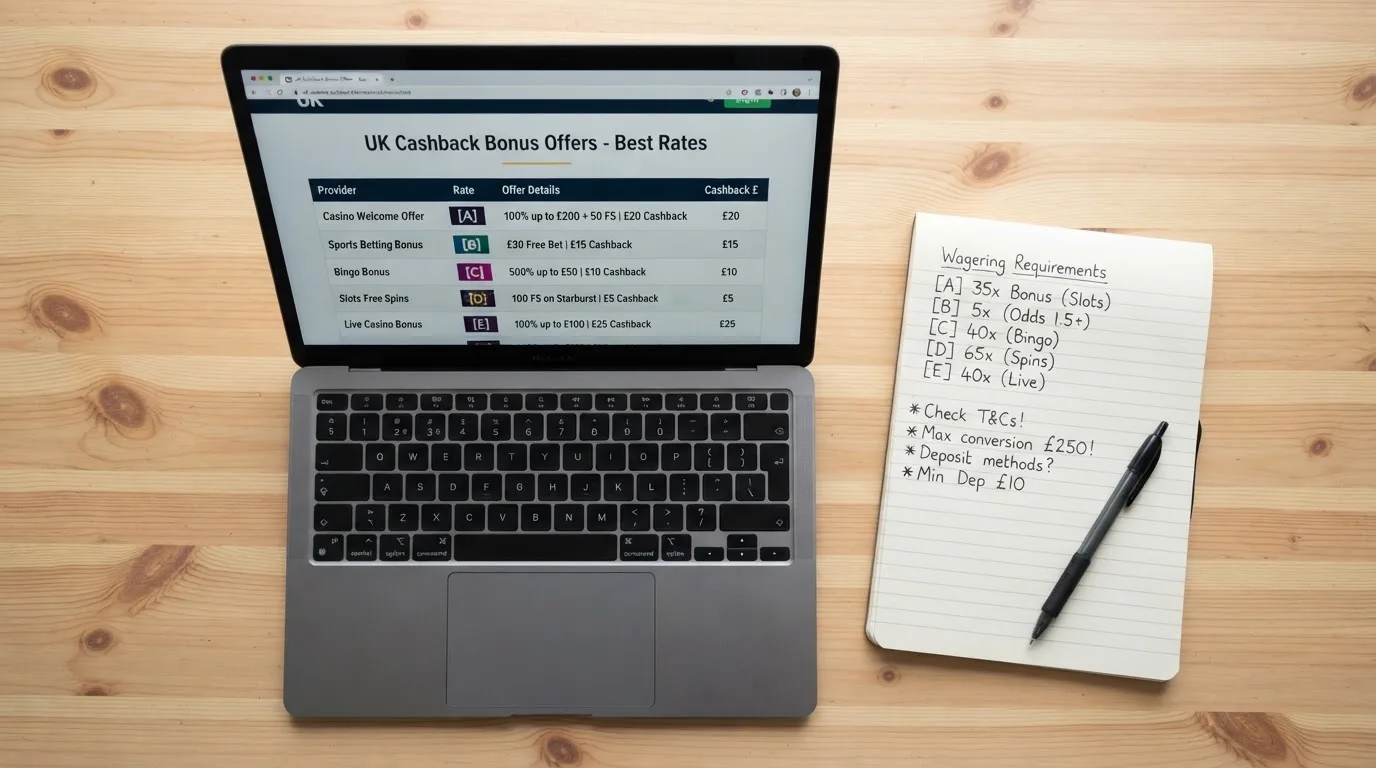
The 139-licence figure is the upper bound on how many independent casino operators can credibly offer a cashback bonus to a UK customer. Some of those 139 are pure B2B platform providers; some are lottery-only or bingo-only licences; some are dormant but not yet removed. The actual number of brands competing for the UK online casino customer is materially smaller than 139, and the number competing seriously on cashback offers is smaller again — though the Commission does not break that subset out.
What that scale means for the player is mostly optionality. The 1065 active domains include roughly seven times more brands than any single comparison page can feature, which means the question “which casino offers the highest cashback” is one that shifts week by week as operators refresh their promotions. The role of the register is not to rank those offers; it is to confirm that each brand offering one holds a valid licence to do so. The promotional comparison is the operator’s job; the licence comparison is the Commission’s.
A second, related, point: most of the 1065 active domains run on a relatively small number of platform providers. The same white-label skin can dress up as a dozen different brands. The cashback terms on those white-label skins are usually a function of the platform’s default configuration rather than the brand’s independent commercial decision. A player who has read the cashback terms at one white-label skin has, broadly, read them at every site the same platform runs — with the cosmetic differences the operator’s marketing team has chosen to apply.
The white-label share — 361 entries on the date above — gives the right order of magnitude for that pattern. Roughly a quarter of the register’s listed sites are not, in any operational sense, independent operators. The remainder, 1065, are the brands running their own promotional strategy on their own licence. The cashback offer the player sees is, in either case, the licence-holder’s commercial call; the brand is the layer on top.
What that structure does to the cashback comparison is harden it. The same cashback offer may appear under three different brand names run by the same operating company. The Commission does not list the offer; it lists the brand, the licence and the domain. The promotional layer sits on top. A player who has compared ten offers and concluded that one brand is the best value may, on inspection, be looking at the same offer the nine other brands also run.
The right comparison frame is therefore the cashback terms rather than the brand name. Two brands run by the same platform with materially different cashback terms are genuinely competing; ten brands run by the same platform with identical terms are not. The Commission’s register makes the platform aggregation visible at the brand level, but the cashback offer sits at a layer below the brand. The player who wants to do the comparison rigorously has to compare the offer’s fine print, not the brand’s marketing skin.
That is also the limit of what the Commission can tell the player. The register confirms a licence; it does not rank offers. The promotional comparison is an editorial exercise the comparison site does, week by week, on a sample of brands. The Commission’s register does the licence check on every brand, on a much slower cadence. The two tasks are different. The player who wants to compare offers needs both — the editorial layer for the offer, and the Commission for the licence.
The market’s commercial dynamics matter in the background. The Remote Gaming Duty the operators pay went from 21 per cent to 40 per cent on 1 April 2026 — a margin pressure that, over time, will tend to thin out cashback offers at the smaller end of the market before reaching the larger ones. The trend is not yet visible in the offer copy at most of the brands in the comparison; it is the kind of pressure that works on a six-to-twelve-month lag. A player who watches the cashback terms week by week will see it before the marketing does.
Licensing, jurisdiction, and the recourse layer
Every casino that takes a customer in Great Britain needs a Gambling Commission licence, regardless of where the operator is based. The Gambling (Licensing and Advertising) Act 2014 closed the previous arrangement — under which an operator could be licensed in another jurisdiction and still serve British customers — and replaced it with a Commission-licence requirement that applies to all of them. A Curaçao, Maltese or Gibraltar licence is no substitute for a Commission licence. A customer playing at an offshore-licensed site is playing at an unlicensed site for the purposes of UK law.

The Commission itself sits under the Department for Culture, Media and Sport, sponsored by DCMS. Its powers come from the Gambling Act 2005, which covers Great Britain — England, Scotland and Wales, but not Northern Ireland, which runs its own regulatory regime. Online casino is a licensable activity under the Act, and the Commission’s public register is the test of whether a brand holds a licence.
The consequences for an unlicensed site serving a GB customer are spelled out in section 33 of the Act: it is an offence for an operator to provide gambling facilities to people in Great Britain without a Commission licence.
| Regulatory Limit | Detail |
|---|---|
| Max Slot Stake (25+) | £5 |
| Max Slot Stake (18-24) | £2 |
| Financial Vulnerability Check | £150 net (30 days) |
| Credit Card Ban | 14 April 2020 |
The Commission’s enforcement toolkit includes cease-and-desist notices, search-engine delisting, and payment and hosting referrals. It does not have power to compel an internet service provider to block access to a site — a point sometimes lost in the marketing of offshore casinos that claim to be available in the UK. The Commission can make a site harder to reach; it cannot make a site unreachable.
The penalty is aimed at the operator, not the player. There is no offence for a player who has wagered at an unlicensed site. What the player loses in that scenario is protection — GAMSTOP enrolment does not apply, the Commission’s complaints process does not apply, and there is no approved alternative dispute resolution route. A player who has had a withdrawal delayed or an account closed at an unlicensed site has, in most cases, only the option of chasing the operator directly. Sometimes that is enough; usually it is not.
The age, identity and payment conditions that apply to a licensed site reflect that stance. The minimum age is 18. Name, address and date of birth must be verified before the first deposit or any play, with the requirement in force since 7 May 2019. Credit cards have been banned for gambling since 14 April 2020, including credit-card-funded e-wallet deposits. The Commission estimated around 800,000 UK consumers used credit cards to gamble in 2018, and found 22 per cent of online gamblers who did so were classed as problem gamblers — the basis for the ban.
Slot stake limits and spin-cadence rules sit alongside the age and identity rules. Online slots carry a maximum stake of £5 per game cycle for players 25 and over (from 9 April 2025) and £2 for 18-to-24-year-olds (from 21 May 2025). Auto-play has been banned since 31 October 2021. A slot spin may not be faster than 2.5 seconds. So-called “losses disguised as wins” — outcomes that present as a win on the screen but net out as a loss — are also banned.
The deposit and stake limits shape what a cashback bonus actually returns. A player who loses £200 in a week at the £5 stake ceiling cannot lose it faster than the 2.5-second cycle allows — roughly fourteen minutes of continuous play for the loss amount, with no auto-play and no turbo spin. The £150 net-deposit threshold for a financial vulnerability check, in force since 28 February 2025, sits beneath the cashback calculation: a player who has deposited that much in a rolling 30 days will be checked against public-data sources before further play.
The deeper protection — and the one the player will most often meet when things go wrong — is the alternative dispute resolution layer. Every licensed operator is required to belong to an ADR provider — typically IBAS or another approved body — that will adjudicate disputes the operator’s own complaints process has failed to resolve. The ADR route is free to the player, takes weeks rather than months, and produces a decision the operator has agreed in advance to honour. A player who has tried the operator’s complaints process and run out of road has, in most cases, only to lodge with the ADR for the case to be reopened.
Where the ADR route also fails, the Commission’s enforcement arm is the third layer. The Commission can investigate, fine, suspend or revoke a licence on the strength of a complaint that has gone through the first two layers. The Commission’s enforcement record over the last several years includes multi-million-pound settlements against operators found to have failed their customer-interaction obligations — the kind of failure that, when it happens, was the consequence of an offer running without the supporting checks. A player who has evidence of a breach should not expect the Commission to act on a single complaint, but the case can be the one that triggers a wider investigation.
On tax: players pay no tax on gambling winnings in the UK. Operators pay Remote Gaming Duty, which the government raised from 21 per cent to 40 per cent from 1 April 2026. The change affects operator margin, not the player return — but it is the kind of margin pressure that, over time, tends to push operators towards thinner cashback offers rather than fatter ones. The trend matters for the comparison across the ten licensed brands even when the individual offer has not yet moved.
Safer gambling around a cashback offer
A cashback offer, by its shape, rewards continued play. A player who has lost £200 in a week and receives £20 back is, by the offer’s logic, a player who should return the next week. The safer-gambling protections around a UK-licensed site are built for that dynamic — they anticipate that the offer, however modest, can become a habit the player did not intend.
The first layer is GAMSTOP, the national online self-exclusion scheme. GAMSTOP enrolment has been a mandatory condition of every UK online gambling licence since 31 March 2020. A player who enrols is excluded from every UK-licensed site for the chosen period — six months, one year or five years — and the exclusion cannot be cancelled early. The enrolment is free, runs once for all operators, and is the single most effective measure a player who feels their gambling has become a problem can take. A cashback offer that hits an enrolled player’s account does not convert; the account is closed to play.
The second layer is the deposit limit. From 31 October 2025, every UK-licensed operator must prompt a customer to set a financial limit before the first deposit, and the limit must be acted on. A player can set a daily, weekly or monthly ceiling, and the operator is obliged to enforce it. The limit is a self-set figure, but the obligation to set one at all — and to set it before any play — is what makes the mechanism work in practice. The cashback calculation runs on losses after the deposit limit has been applied; the limit sits ahead of the offer, not behind it.
The third layer is the financial vulnerability check. Since 28 February 2025, a player who has deposited £150 net in a rolling 30 days is checked against public-data sources — credit reference files, court judgments, the standard insolvency registers — before further play. The check is publicly sourced; it does not require the player to provide additional documents at this stage. A wider financial risk assessment, using data the player supplies directly, has been announced but is not yet in force. A player who triggers the public-data check may have their account paused while the operator decides what action to take; the offer continues running in the background, but the player cannot reach it.
The fourth layer is the slot stake limit itself. A £5 ceiling for the 25-and-over bracket and £2 for the younger bracket is also a safer-gambling measure, in addition to a consumer-protection one. The 2.5-second minimum spin cadence — part of the same Remote Technical Standards — sits in the same category. The cashback offer is most attractive on fast-spinning slots; the cadence rule cuts off the shortest clearing paths. The 10x wagering cap does the same, by making a high-wagering cashback offer structurally less viable. None of these were designed with cashback in mind; all of them reshape the cashback math in passing.
Outside the licence framework, the National Gambling Helpline (run by GamCare) and the support services funded by GambleAware are the right referral points for a player who wants to talk through a concern. GamCare’s helpline is free, confidential and available around the clock. GambleAware funds a wider network of treatment and support providers. A player who has begun to chase losses, or who has noticed that a cashback offer is changing how they approach the next week’s play, has a route to confidential help that does not depend on the operator.
The deeper point is that the safer-gambling regime is built around the assumption that a cashback offer is also a marketing channel — and that the player is a more reliable judge of their own situation than the operator’s promotional team will be. The protection is in the architecture of the offer, not in the offer itself. A £10 weekly cashback is a small reward for a substantial loss; the GAMSTOP and deposit-limit mechanisms exist so that the loss does not grow past the point the player can sustain. The offer’s headline is the visible part; the safety net is the regulatory floor underneath it.
The offer’s design reinforces the dynamic. A weekly cashback credited on Monday, with the wagering due by Sunday, is structured around a player who comes back each week. A monthly cashback, credited at the start of the next month, is structured around a player who has not enrolled in GAMSTOP. The marketing is the same in both cases — a percentage of net losses, a cap, an eligible-games list. The cadence is the safer-gambling tell, and the player who wants to read the offer honestly should read it. Most do not.
What each licence-holder tells the player
The notes below sketch what each operator’s licence-holder tells the player about recourse, and what is distinctive about the licence arrangement. None of the ten is being recommended as the best cashback operator — the cashback terms sit on the operator’s own promotions page, and the Commission register does not rank offers.
Virgin Games — the only white-label in this set
Virgin Games trades under Gamesys Operations Limited’s licence 038905-R-319430-022. The white-label status means the player is, in practice, dealing with Gamesys for the back-end — KYC, complaint handling, ADR. A player who has registered at Virgin Games has registered with the same operator as a player at Jackpotjoy, the other Gamesys brand on the list.
Betfred — the Petfre Gibraltar licence-holder
Betfred sits on Petfre (Gibraltar) Limited’s licence 039544-R-319290-010. The Gibraltar operating company is unusual in this set; the rest are either UK or Malta-rooted. The Commission’s licence number is what matters for UK recourse, and the player’s route to complaint runs through the same Commission processes that apply to any other UK-licensed brand.
Betfair — the PPB Games platform
Betfair sits on PPB Games Limited’s licence 039411-R-319335-010. PPB Games is the Flutter subsidiary that runs the Betfair, Paddy Power and Sky Betting brands in the UK; the licence is the route through which the Commission’s conditions apply to all three. A player at Betfair is, for compliance purposes, at the same operator as a player at Paddy Power.
Sky Vegas — the Bonne Terre Gaming licence
Sky Vegas sits on Bonne Terre Gaming Limited’s licence 065519-R-339675-002. The operator is best known through its Sky-branded consumer products; the Commission’s licence is the consumer-protection layer. The licence number is the highest in this set, in the sense that it carries the most recent suffix.
Gala Bingo — the LC International umbrella
Gala Bingo sits on LC International Limited’s licence 054743-R-330863-014. LC International is the Entain subsidiary that runs the Ladbrokes, Coral and Gala-branded sites; a player at Gala Bingo is, in practice, at the same operator as a player at Ladbrokes. The cashback terms on each may differ; the licence and complaint route do not.
32Red — the Platinum Gaming licence
32Red sits on Platinum Gaming Limited’s licence 045322-R-324275-019. Platinum Gaming is the Kindred Group subsidiary that runs the 32Red brand; the licence covers the brand and any white-label extensions on the same platform. The brand has one of the longer-standed UK licences in this set.
Casumo — the Recro Limited licence
Casumo sits on Recro Limited’s licence 061549-R-336718-002. Recro is the operating company behind the Casumo brand; the licence is the route through which the Commission’s conditions apply. The player who registers with Casumo has registered with Recro for the purposes of any dispute.
Midnite — the Dribble Media licence
Midnite sits on Dribble Media Limited’s licence 042647-R-321653-022. Dribble Media is the operating company behind the Midnite brand; the brand’s positioning in the UK market is a smaller-scale consumer offering rather than a tier-1 platform. The licence is current; the brand’s profile is modest.
PokerStars — the Stars Interactive licence
PokerStars sits on Stars Interactive Limited’s licence 039108-R-319334-026. Stars Interactive is the Flutter subsidiary that runs the PokerStars and Sky-branded gaming products; a player at PokerStars UK is, in compliance terms, at the same Flutter-level operator as a player at Betfair. The .uk domain is also distinctive in this set.
Jackpotjoy — the sister brand to Virgin Games
Jackpotjoy sits on Gamesys Operations Limited’s licence 038905-R-319430-022 — the same licence Virgin Games trades under. The brand is, in this set, the active-domain counterpart to the white-label Virgin Games entry; the operating company is identical, and the player-side recourse is the same. The cashback offer may differ between the two brands; the licence and complaint route do not.
Frequently asked questions
How is a casino cashback bonus usually calculated?
A cashback bonus is, in the standard UK shape, a percentage of net losses over a fixed period — usually a calendar week. The percentage runs from five to twenty per cent. The return is then subject to a wagering condition, capped at 10x since 19 December 2025, before it can be withdrawn. Many schemes also cap the maximum return at a fixed amount — £50, £100, £200.
Can a crypto-funded casino account qualify for cashback?
At a UK-licensed casino, yes — the offer is calculated on net losses, not on the payment method. Verification at the casino runs regardless of funding source, including for crypto deposits. An offshore crypto casino may offer cashback without verification, but with none of the UK protections — no GAMSTOP, no Commission complaints route, no approved ADR.
What does the 10x wagering cap mean for a cashback bonus?
The cap, in force since 19 December 2025, means a £10 cashback sets £100 of required wagering before it can be withdrawn. At a £5 slot stake, twenty spins clear it; at £2, fifty. The cap replaces the 50x and 100x factors that older UK offers used to carry — and that offshore sites still apply — making a cashback offer meaningfully more generous than the historical UK shape.
How does a UK-licensed cashback site differ from an offshore one?
A UK-licensed site runs under Gambling Commission supervision, with mandatory GAMSTOP enrolment, ADR options for disputes, and identity verification before first play. An offshore site — Curaçao, Malta, Gibraltar — operates under its home regulator only. A player with a dispute at an offshore site has, in most cases, only the operator to take it up with directly.
Is a cashback bonus paid in cash or as restricted bonus funds?
At most UK-licensed casinos the cashback is paid as bonus funds, with the 10x wagering cap the only condition before it converts to withdrawable cash. A minority of operators pay cashback as cash, with no wagering — the better deal, when it is offered. The terms of each promotion name which shape applies; the player should check before claiming.
Prepared by the lowdepositcasinouk editorial staff.