
What follows for a UK player who wants to play Aviator
 Available in GB
The Aviator crash game sits in a particular place in the British market: it is a single product, sold by one studio, sitting on the lobby pages of operators whose names already appear on the Gambling Commission’s public register. The mechanics are not complicated — a multiplier rises, the player decides when to cash out, the round ends when it crashes. What is complicated, and what most marketing copy does not explain, is the regulatory shell around that one product: who may sell it, who may buy it, what limits apply, and what the bonus terms attached to it actually demand.
As of 23 September 2026 against the Gambling Commission’s public register.
Table of Contents
- The fundamentals of the UK licensed market for Aviator
- Aviator at licensed UK casinos — the legal frame
- Safer play at a GB-licensed Aviator casino
- Cryptocurrency deposits and the anonymity question at UK Aviator casinos
- Bonuses and free spins attached to UK Aviator play
- Playing Aviator on mobile at a UK casino
- Aviator paytable and cash-out mechanics
- Side games and live tables alongside Aviator
- The licensed operator landscape — a comparison of UK Aviator casinos
- The wider read of the licensed UK market
- What the limit on bonus turnover means for a real Aviator offer
- Frequently asked questions
The fundamentals of the UK licensed market for Aviator
A crash game is one of the simplest products the licensed UK market sells. Spribe released the first widely distributed version in 2019, and Aviator is now the studio’s flagship. The studio’s own description positions it as the first real-money multiplayer crash format in the regulated iGaming space, and the volume — Spribe reports more than 42 million active users and roughly 350,000 bets per minute across the operator base — explains why so many GB-licensed lobbies carry it.

The product is one game on a regulator’s list of permitted categories. What makes a UK Aviator session different from an identical session in another jurisdiction is not the curve but the licence under which the operator runs it. The Gambling Commission’s public register is the test of that licence: a brand not listed there has no business taking deposits from someone sitting in Great Britain. The register is searchable online, downloadable in CSV form, and the version on 18 September 2026 listed 139 businesses holding an active remote casino operating licence. The same register’s domain list held 1065 active and 361 white-label entries on the same date, which is the practical upper bound on the number of casino sites a UK player can be served by without falling foul of section 33 of the Gambling Act 2005.
A licence number on the register has a recognisable shape: a six-digit account number, an “R” for remote, a sequence number, and a suffix. 039411-R-319335-010 is the licence PPB Games Limited uses to run Paddy Power. Every brand in the comparison below traces back to one of those strings.
Aviator at licensed UK casinos — the legal frame
A player in Great Britain may legally wager on Aviator only through a Gambling Commission licensee. The Gambling (Licensing and Advertising) Act 2014 closed the route by which operators based elsewhere could serve British customers on a home-country licence, and section 33 of the Gambling Act 2005 still treats any supply to players in Great Britain without a GB licence as an offence. The penalty the Act aims at the operator, not the player — but the player is the one who loses the protection a GB licence brings, and that loss is not recoverable.

Identity is part of the deal. Since 7 May 2019, an operator must verify name, address and date of birth before accepting a first deposit or letting the customer stake anything. A crypto route that promises anonymity is not a route that exists at a GB-licensed casino. The same licensed operator must run GAMSTOP enrolment checks, must offer self-exclusion at six months, one year or five years, and must prompt a customer to set a financial limit before the first deposit — that prompt has been mandatory since 31 October 2025.
The stake ceiling on online slots that the Commission introduced in 2025 does not apply to Aviator. The £5-per-game-cycle cap for adults aged 25 and over (in force from 9 April 2025) and the £2 cap for 18-to-24-year-olds (in force from 21 May 2025) cover reel-based online slots only. The Commission’s own guidance is explicit: the cap does not extend to other casino games. Aviator, as a crash title, is governed by the operator’s own maximum stake and table limit, not by the slot cap. The £2.5-second minimum spin cycle that came in alongside the stake cap applies to slots, not to a game whose round lasts the time it takes for the multiplier to crash. Auto-play, banned for online slots since 31 October 2021, is a slot feature — Aviator has no equivalent to switch on.
The shape of the bonus terms that attach to Aviator is set by the same Commission. Since 19 December 2025, wagering requirements on bonuses have been capped at 10x, and mixed-product bonuses (the kind that stake a sports bet to unlock casino spins) are no longer permitted. The full impact of the cap, and the calculation it forces on a real offer, is taken up in the section on bonus structure below.
Safer play at a GB-licensed Aviator casino
The same safer-gambling machinery that protects play on slots protects play on Aviator, with one practical difference the rules make for the crash format.
GAMSTOP enrolment is a condition of every GB online licence since 31 March 2020. A player who has self-excluded for six months, one year or five years is blocked from any licensed operator’s product list, Aviator included. The exclusion cannot be cancelled early, which is the protection most worth naming when a player asks whether the scheme is enforceable.
Financial vulnerability checks have run since 28 February 2025 at a £150 net-deposit threshold in a rolling 30 days, using publicly available data. The checks are designed to flag customers whose deposit pattern has shifted in a way that suggests harm, and they apply equally to crash-game play. Wider financial risk assessments have been announced but are not yet in force.
Reality checks are operator-set rather than statute-set. The minimum 2.5-second game cycle on slots is the Commission’s fix for one specific failure mode — a player losing track of time — and Aviator’s rounds, which can last anywhere from a fraction of a second to a minute, sit outside that exact rule. A licensed operator is still expected to provide reality checks, time-out settings, and self-exclusion at the product level; the customer can also reach the National Gambling Helpline (GamCare) and GambleAware from any operator’s safer-gambling page.
Deposit limits are not state-set. A player sets their own at registration, prompted to do so before the first deposit, and may revise them afterwards, subject to a cool-down on increases. The credit-card ban that has been in force since 14 April 2020 — including cards routed through e-wallets — applies to Aviator deposits exactly as to any other casino product.
Cryptocurrency deposits and the anonymity question at UK Aviator casinos
Crypto is a real deposit option at some GB-licensed casinos, and Aviator is a real product on the same lobbies. The two facts sit side by side without contradiction only because a GB licence forces a particular structure on both.
A licence holder must verify name, address and date of birth before accepting a first deposit, regardless of the funding instrument. The identity check applies to a Bitcoin deposit the same way it applies to a debit-card deposit. A player who wants to deposit in Bitcoin at a GB-licensed casino still produces the same documentation they would for any other payment method, still hits the same GAMSTOP enrolment check, and still falls under the same self-exclusion rules. The “anonymous Aviator” promise that some marketing carries is not a promise a Commission licensee can keep.
The deposits themselves are processed through the same operator treasury. Some GB-licensed operators publish a list of accepted cryptocurrencies — Bitcoin, Ethereum, Litecoin and Tether recur in that list — and exchange them into pounds on receipt, or hold them on a player wallet at the prevailing rate. The mechanics are operator-specific; what is not operator-specific is that the winnings come back through a verified channel. A withdrawal to a crypto wallet still goes to a wallet the operator has on file.
The comparison below treats crypto support the way the register treats it: where the operator’s own materials list the method, the row says so, and where they do not, the row carries the no-data marker rather than a guess.
Bonuses and free spins attached to UK Aviator play
A welcome offer attached to Aviator at a GB-licensed casino is one of three shapes: a deposit-match bonus with the standard 10x wagering cap, a fixed number of free rounds on a named slot, or a no-deposit free-spins offer. The shapes are operator-set; the cap that governs all of them is the Commission’s, and the cap took effect on 19 December 2025.
The 10x cap is the line the calculation below starts from. A bonus of £50 carries a required turnover of £50 × 10 = £500 before any winnings are withdrawable; a £100 bonus carries £1,000 of turnover; a £200 bonus carries £2,000. The exact playthrough rule varies by operator — some count the bonus alone, some count deposit plus bonus, and that distinction moves the required turnover by a factor of two without changing the headline offer.
Free spins are a separate case. Spins attached to a welcome package are normally capped in their cash-equivalent value (often 10p per spin), carry their own wagering requirement on winnings (capped at 10x under the new rules), and frequently carry a maximum-cashout cap that limits the realisable value of the bonus. The cap was historically the most expensive line in a free-spin offer, and the 10x cap does not address it.
The calculation below takes the 10x cap as a fixed input and reads the real cost of a bonus against the time the player is expected to put in. A £100 bonus at the 10x cap means £1,000 of turnover to clear it. At a £1 stake per round and a typical round length of a few seconds, that turnover runs into a long session — many minutes of continuous play, and the session is the place where the cost of the bonus actually lives.
The wagering cost of a UK Aviator bonus under the 10x cap
The Commission introduced the 10x wagering cap on 19 December 2025 to address offers whose playthrough demands had drifted past anything a casual player could clear in a reasonable session. The cap sits well below the 30-to-50x multiples that were the pre-2025 norm at some operators, and the gap is the headline.
A £100 bonus now carries £1,000 of required turnover; a £200 bonus carries £2,000. The “how long to clear it” answer depends on the stake and the round length. At a £1 stake per round, £1,000 of turnover is 1,000 rounds. A round that ends in five seconds is roughly 1.4 hours of continuous play; a round that ends in ten seconds is roughly 2.8 hours. The same arithmetic at £2 per round halves both numbers. None of those figures is small.
The same calculation produces a “how much does it cost” answer. The expected loss on £1,000 of turnover at the house edge typical of a crash game sits in a band — the edge varies by operator, and Aviator’s published RTP sits in the upper-90s but is not 100. A back-of-the-envelope expected loss on £1,000 of turnover at a 3% edge is £30; at a 4% edge it is £40; at a 5% edge it is £50. None of those is the headline figure the welcome offer advertises, and none of them is zero.
The honest reading of a welcome offer under the 10x cap is that the cap lowered the maximum possible cost without removing it. A bonus that asks for £500 of turnover is cheaper than a bonus that asked for £5,000; it is still £500 of play the player has to complete before any winnings become theirs, and the time and the expected loss on that £500 are still real.
Playing Aviator on mobile at a UK casino
The shape of the Aviator product on a phone is the same as it is on a desktop: a multiplier curve, a stake input, a cash-out button. The differences between browser and app are operational, not mechanical.
A browser session runs through the operator’s responsive site. The product is built in HTML5 and renders at any modern viewport; the only real concern is the connection quality, because a dropped round is a round the player has already staked on. A dedicated app — where one exists — typically mirrors the lobby structure, carries the safer-gambling controls in a more accessible position, and offers biometric login. Some operators do not offer a dedicated app and serve all mobile play through the browser; the Commission’s product rules do not require an app.
The deposit flow is the same on a phone as on a desktop: identity-checked, GAMSTOP-checked, payment-method-checked. The faster-spin / auto-play features banned on slots since 31 October 2021 were slot-specific and do not translate to Aviator. The 2.5-second minimum game cycle on slots is a slot-specific rule; an Aviator round that ends in a fraction of a second is still operating inside the product’s own RNG.
Reality checks on a mobile session are operator-set. A session that runs longer than the operator’s threshold triggers a pop-up showing time and net position; the player may close it and continue. A time-out setting locks play for a chosen window (24 hours, one week, one month). A self-exclusion request goes to the operator’s safer-gambling team and is processed within 24 hours at a GB-licensed site.
Aviator paytable and cash-out mechanics
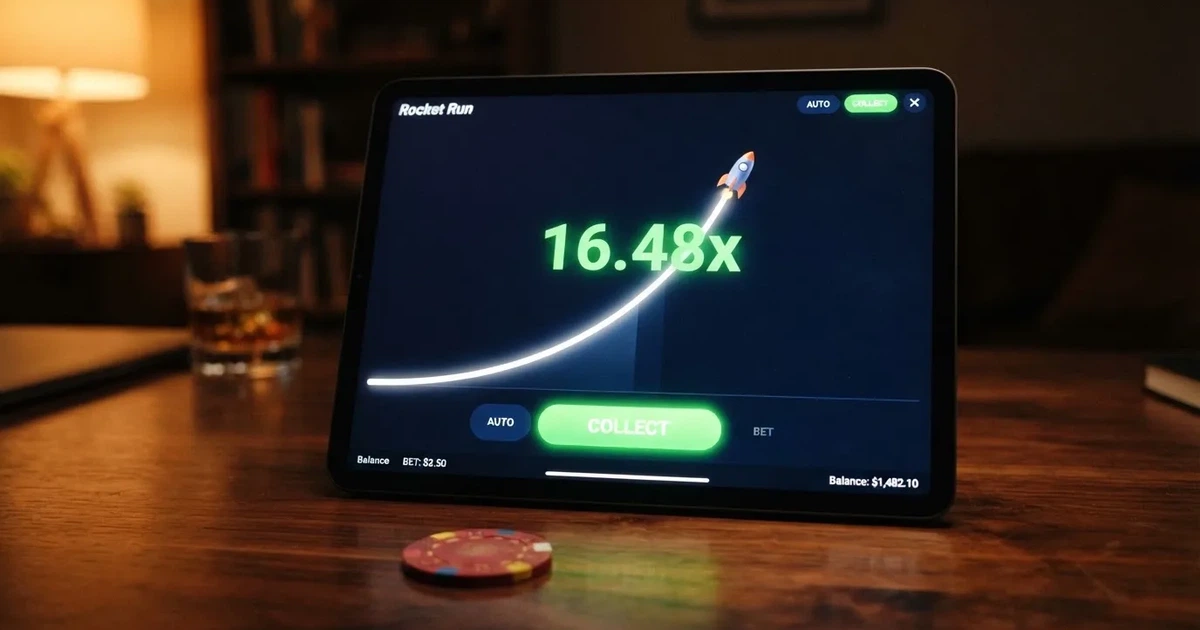
The mechanics of the round are short and worth stating once. Spribe’s Aviator launches a round with a multiplier starting at 1.00x; the multiplier climbs at a speed the round decides; the round crashes at a multiplier the player does not see in advance. A player who has staked on the round must cash out before the crash to win the stake multiplied by the value at the moment of cash-out. A player who does not cash out loses the stake.
The crash point is random within a band the studio publishes. The studio describes the format as the first true multiplayer crash game in the regulated iGaming space, and the multiplayer element — a live feed of other players’ stakes and cash-outs — is the social hook. The maximum multiplier a round can reach before crashing has no fixed ceiling; the curve can in principle run into the hundreds, but the probability of any given crash point falls as the multiplier rises.
The decision is the entire game. A player who cashes out at 1.20x wins 20% on the stake; a player who waits for 5.00x and gets it wins five times the stake. A player who waits and the round crashes at 1.10x loses everything staked. The expected value over a long session is negative for the player — the house edge takes a slice on every round, and the slice is the price of admission.
A licensed UK operator publishes the RTP for its Aviator build alongside the game. The RTP sits in the upper-90s by Spribe’s own published figure, with the exact number set by the operator. The volatility profile is high — most rounds crash early, with the long-tail wins carrying the bulk of the return. A player who treats Aviator as a slow grind will lose; a player who treats it as a high-variance title with long losing streaks between wins has the right expectation.
The paytable in a practical sense is the multiplier curve. The cash-out mechanic is the player’s only decision. The bet size is the only other input the player controls. There is no skill element to Aviator in the way there is skill in blackjack or poker — the multiplier is random, the cash-out is a choice under uncertainty, and the expected value over a session is the house edge.
Side games and live tables alongside Aviator
The crash game sits in a lobby that carries other products the player will see at the same site. The wider British online casino product is a mix of slots, table games, and live-dealer tables; the regulated shape of each is what the Commission has set across recent rule changes.
Slots are the most affected by the 2025 package of changes. The £5-per-game-cycle cap for adults 25 and over (from 9 April 2025) and the £2 cap for 18-to-24-year-olds (from 21 May 2025) apply to reel-based online slots only. The minimum 2.5-second spin cycle applies to slots only. The auto-play ban that took effect in 2021 applies to slots only. Aviator, as a crash title, sits outside these rules — the operator sets its own stake limits, round length and product features.
Table games — baccarat, roulette, blackjack — are governed by the table rules the operator publishes. The Commission’s guidance on the 2025 stake cap is explicit that the cap does not extend to table games. Baccarat carries its own house edge depending on the bet: 1.06% on the banker bet and 1.24% on the player bet in the Punto Banco variant that dominates the British lobby, with the tie bet at a much heavier 14.4% (paid 8-to-1) or 4.85% (paid 9-to-1) depending on the table’s paytable. Roulette carries its own edge depending on the wheel: a single-zero European wheel gives the house roughly 2.7%, a double-zero American wheel gives it roughly 5.3%. Blackjack’s edge varies with the rule set but sits under 1% on a player who plays basic strategy.
Live-dealer tables stream from studios the operator runs or contracts. The safer-gambling controls on a live-dealer session are the same as on any other product — GAMSTOP enrolment, deposit limits, reality checks, time-outs — and the stake ceiling on a live table is set by the operator rather than by the slot cap. A live-dealer Aviator, where one exists, sits in the same live-dealer lobby as live-dealer roulette and live-dealer blackjack.
The wider licensed UK market carries more than Aviator. The same Commission’s register holds the names of 139 active remote casino operating licensees; each operates a lobby that ranges from a slots-heavy site to a table-game-heavy site to a bingo-led site. Bingo’s own history in Britain runs from the 1960 Betting and Gaming Act and Mecca Bingo’s hall expansion to today’s online products, and the £5/£2 slot caps do not extend to bingo, which is its own regulated category.
The licensed operator landscape — a comparison of UK Aviator casinos
The comparison below reads the Gambling Commission’s public register of 18 September 2026 against ten operators. Each row carries the brand name, the licence-holder company and the GB remote casino licence number, the domain’s status on the register (Active or White Label), and the subject support row’s verdict on the Aviator product — which is “no-data” throughout, because the public register does not record which games a licensee carries, and the operator’s own materials are the only honest source for that list.
| Brand | Licence holder | Domain status |
|---|---|---|
| Paddy Power | PPB Games Limited | Active |
| Unibet | Platinum Gaming Limited | Active |
| Sky Vegas | Bonne Terre Gaming Limited | Active |
| kwiff | Eaton Gate Gaming Limited | Active |
| bet365 | Hillside (UK Gaming) ENC | Active |
| MrQ | Tek Fox Ltd | Active |
| Midnite | Dribble Media Limited | Active |
| Virgin Games | Gamesys Operations Limited | White Label |
| BetVictor | BV Gaming Limited | Active |
| Grosvenor Casinos | Rank Interactive (Gibraltar) Limited | Active |
| Bonus Term | Detail |
|---|---|
| Wagering Cap | 10x |
| Mixed Bonus | Banned since 19 Dec 2025 |
| Max Cashout | Operator-set |
The white-label status on Virgin Games is worth flagging in its own right. The Commission’s register distinguishes Active from White Label: a white-label site trades under another company’s licence. The games on a white-label site are typically the same catalogue the parent operator carries, and the safer-gambling machinery is the parent’s, not the brand’s. A player who self-excludes through a white-label site’s safer-gambling page is self-excluding at the licensee, which is the protection that matters.
Paddy Power
Paddy Power sits under PPB Games Limited on the Commission’s register, licence 039411-R-319335-010. The brand’s history as a licensed UK operator runs long enough that the licence is a settled point rather than an open question; the safer-gambling infrastructure is the parent group’s, and the GAMSTOP enrolment at signup is the same as it is at any other Commission licensee. Where the brand’s own materials list Aviator, the game sits in a lobby that also carries the wider Paddy Power product set. Paddy Power is an established name that integrates Aviator into its existing portfolio rather than making it the primary focus.
Unibet
Unibet runs under Platinum Gaming Limited, licence 045322-R-324275-019, with unibet.co.uk on the register. Platinum Gaming is one of the larger UK licensees by licence count, and the brand carries the kind of product depth a long-running operator builds up — sports, casino, live casino, and a games lobby that has evolved rather than been launched last quarter. Where Unibet lists Aviator, the brand’s safer-gambling controls and the parent group’s GAMSTOP infrastructure are the things a player can rely on. The judgement on the brand is that the operator’s strength is product breadth; the absence of a marketing push around Aviator is consistent with how the wider lobby is presented, and a player who wants Aviator in a multi-product account rather than a single-game site has Unibet on the list.
Sky Vegas
Sky Vegas sits under Bonne Terre Gaming Limited, licence 065519-R-339675-002. The brand’s positioning is a slots-led lobby under the Sky name, and the safer-gambling infrastructure is Bonne Terre’s. Aviator, where the brand lists it, sits alongside the slots the lobby otherwise carries. The brand draws traffic from the wider broadcast presence, meaning the Aviator title is one among many, and typically found by those already engaged with the Sky Vegas ecosystem.
kwiff
kwiff runs under Eaton Gate Gaming Limited, licence 044448-R-323408-017. The brand has built its position around a surprise-mechanic on its odds and stakes — a stake that lands a surprise boost lands the player more than the headline multiple. Aviator, where the brand lists it, sits inside that positioning rather than outside it; the surprise element is on the stake rather than on the game itself. kwiff attracts players looking for unconventional framing, with safety infrastructure provided by Eaton Gate.
bet365
bet365 sits under Hillside (UK Gaming) ENC, licence 055149-R-331499-004. The brand is the largest UK-licensed operator by some distance, and the licence count is the largest in the Commission’s register. Aviator, where the brand lists it, sits inside a product catalogue that runs into the thousands of titles, and the safer-gambling infrastructure is the parent group’s. Aviator is offered as a minor addition to the expansive selection, consistent with how the brand manages its vast library.
MrQ
MrQ runs under Tek Fox Ltd, licence 060629-R-337532-004. The brand’s positioning has historically been on transparency — no wagering requirements on certain promotions — and that positioning sits inside the Commission’s pre-2025 rules and the post-2025 10x cap equally. Aviator, where the brand lists it, sits alongside the wider MrQ catalogue. MrQ provides a direct approach to bonus terms, which appeals to players seeking clarity.
Midnite
Midnite runs under Dribble Media Limited, licence 042647-R-321653-022. The brand is one of the newer entrants to the Commission’s register, and the licence is the standard remote casino operating licence rather than a special category. Aviator, where the brand lists it, sits inside a lobby that carries the usual mix of slots and table games. Midnite appeals to those preferring fresh branding while maintaining standard licensed-operator protections and safety protocols.
Virgin Games
Virgin Games runs under Gamesys Operations Limited, licence 038905-R-319430-022, with Virgin Games on the register as a white-label domain. The white-label status is the practical point: the licence is Gamesys Operations Limited’s, and the safer-gambling machinery is Gamesys’s, not Virgin Games’. Aviator, where the brand lists it, sits inside the Gamesys catalogue, which the white-label site runs under the Virgin brand. The judgement on Virgin Games is that the brand is a familiar consumer name carrying a familiar licence — the protection is the same as at any other Gamesys-operated site, and the product mix is the parent operator’s. A player who wants the Virgin brand name on the lobby has Virgin Games on the list, with the understanding that the licence is Gamesys’s, not a Virgin entity’s.
BetVictor
BetVictor sits under BV Gaming Limited, licence 039576-R-319370-028. BV Gaming is one of the larger UK licensees by licence count, and the brand’s history as a sports-led operator has carried over into a casino and live casino product. Aviator, where the brand lists it, sits inside a product catalogue that combines the sports heritage with a casino-led lobby. BetVictor leverages its sports foundation to provide a unified environment for players interested in mixed products.
Grosvenor Casinos
Grosvenor Casinos sits under Rank Interactive (Gibraltar) Limited, licence 057924-R-334666-005. The brand has a high-street heritage as a casino operator — the land-based Grosvenor estate is a known presence in British high streets — and the online operation carries the same brand name. Aviator, where the brand lists it, sits inside an online product that runs alongside the bricks-and-mortar business. Grosvenor utilizes its high-street reputation to foster online trust for players already accustomed to its physical locations.
The wider read of the licensed UK market
Ten operators sit on the comparison above, and the Commission’s register of 18 September 2026 holds 139 active remote casino operating licences. The ten are a sample, not the whole field. The 129 operators not on the comparison have their own licence numbers, their own product catalogues, and their own safer-gambling infrastructure, and a player searching the register directly will find them in the CSV download. The Commission’s register is the only honest source for whether a brand holds a GB licence, and the test is the licence account, not the brand name.
The market’s shape has shifted under the 2025 rule changes. The 10x wagering cap that took effect on 19 December 2025 cuts the maximum bonus cost by a large factor; the slot stake cap that took effect on 9 April 2025 (adults 25+) and 21 May 2025 (18-to-24) cuts the maximum stake on a slot round; the financial vulnerability check that took effect on 28 February 2025 at £150 net deposits in a rolling 30 days adds a new layer of monitoring. Each rule applies to a specific product category and not to others — Aviator, as a crash game, is governed by the operator’s stake ceiling rather than by the £5/£2 slot cap.
The customer-facing effect of the rules is uneven. The 10x cap reduces the maximum cost of a bonus but does not remove it — a £100 bonus at 10x still demands £1,000 of turnover, and the expected loss on that turnover is still a cost the player is paying. The slot stake cap changes what a player can stake on a reel-based slot but does not change what they can stake on Aviator. The financial vulnerability check adds a prompt at £150 net deposits that the operator runs against publicly available data.
The combined shape of the British licensed market for Aviator is one regulated product, sold by one studio, sitting on the lobby pages of operators whose licence numbers sit on the Commission’s register, with a bonus structure capped at 10x, a deposit process that requires identity verification, and a self-exclusion scheme (GAMSTOP) that blocks every licensed site at once. A player who wants to play Aviator legally in Great Britain plays it at one of those operators. A player who plays it at an unlicensed site loses the protection the licence brings — no GAMSTOP, no Commission complaints route, no ADR — and the penalty for the operator is the Commission’s, not the player’s.
What the limit on bonus turnover means for a real Aviator offer
The 10x cap is the line that defines how a bonus actually plays. A bonus of £100 with 10x wagering asks for £1,000 of playthrough; a bonus of £50 with 10x wagering asks for £500. The required turnover, divided by the stake per round, is the number of rounds the player has to complete. A £1 stake and £1,000 of turnover is 1,000 rounds; a £2 stake is 500 rounds.
The time those rounds take depends on the round length. An Aviator round can last a fraction of a second or run into many seconds; the round length is the variable the player does not control. A round length of five seconds makes 1,000 rounds roughly 1.4 hours of continuous play; a round length of ten seconds makes the same number of rounds roughly 2.8 hours. The same 1,000 rounds at a £2 stake halves both the round count and the time. None of those numbers is small, and a player who enters the bonus with a plan to clear it in a short session will not clear it.
The expected loss on the playthrough is a separate line. An Aviator session at the published RTP carries a house edge that runs in single-digit percentages; the exact figure is operator-specific and game-version-specific. At a 3% edge, £1,000 of turnover carries £30 of expected loss; at a 4% edge, £40; at a 5% edge, £50. The expected loss is the price of clearing the bonus, and it is a price that comes off the bonus before the player sees any withdrawal.
The honest position on a £100 bonus at 10x wagering is that the bonus is worth roughly the bonus amount minus the expected loss on clearing it. At a 3% edge, that is £100 minus £30, or £70 in realisable value. At a 4% edge, that is £60. The Commission’s 10x cap lowered the maximum possible loss but did not remove it, and a player who treats the bonus as a £100 windfall has not read the terms.
Frequently asked questions
How does the cash-out mechanic in Aviator actually work?
A multiplier rises from 1.00x when the round opens; the player who has staked on the round decides when to cash out, and the stake is multiplied by the value at that moment. A round crashes at a multiplier the player does not see in advance, and a stake left on the table at the crash is lost. The decision is the entire game, and there is no skill element — the multiplier is random, and the expected value over many rounds is negative for the player.
Can Aviator be played using cryptocurrency deposits?
Crypto is a real deposit option at some GB-licensed casinos, and Aviator is on the same lobbies, but the identity check applies equally to a Bitcoin deposit and a debit-card deposit. A player who deposits in crypto at a GB-licensed casino still produces the same documentation, still hits the GAMSTOP enrolment check, and still falls under the same safer-gambling rules. The “anonymous Aviator” promise some marketing carries is not one a Commission licensee can keep.
Does Aviator come with its own welcome bonus at licensed sites?
A welcome offer attached to Aviator at a GB-licensed casino is one of three shapes — a deposit-match bonus with a wagering requirement (capped at 10x since 19 December 2025), a fixed number of free spins on a named slot, or a no-deposit free-spin offer. Each shape carries its own terms, and the wagering cap applies to all three. The exact offer is operator-specific.
Is Aviator available through a dedicated mobile app or only a browser?
Both. The product runs in a browser on a mobile device through the operator’s responsive site, and some operators also carry a dedicated app that mirrors the lobby. The Commission’s product rules do not require an app, and an operator that does not offer one is not in breach. The product on a phone is the same product as on a desktop, and the deposit flow is the same.
What is the maximum multiplier Aviator can reach before a round ends?
There is no fixed ceiling. The multiplier curve can run into the hundreds in principle, but the probability of any given crash point falls as the multiplier rises, and the volatility of the game is high. The published RTP sits in the upper-90s by Spribe’s own figure, with the exact number set by the operator’s game build. Most rounds crash early, and the long-tail wins carry the bulk of the return.
Is the Aviator casino game legal to play for UK residents on a licensed site?
Yes, on a Gambling Commission licensee. The Commission’s public register is the test of whether a brand holds the licence, and the register on 18 September 2026 listed 139 businesses holding an active remote casino operating licence. The 10 brands on the comparison above all hold that licence. A player who plays Aviator at an unlicensed site is not breaking the law themselves, but the operator is breaking section 33 of the Gambling Act 2005, and the player loses the protection a GB licence brings — no GAMSTOP, no Commission complaints route, no ADR.
Created by the ”lowdepositcasinouk” editorial team.