Best bingo casinos UK: the licensed shortlist and what each one really pays in 2026
 Available in GB
A bingo casino is, on paper, a strange hybrid. The halls that made the game a British institution still draw a crowd, but most players who search for a place to play now do so on a phone, and what lands on that phone is rarely a single product. The lobby shows a bingo room beside a slots library, and sometimes a live-dealer section too — three different products behind one account, one wallet, one set of rules. Comparing those products is what this page is for, and the comparison runs on a single principle: a UK-facing site needs a Gambling Commission licence before anything else matters. Everything below — the bingo rooms, the slots, the bonus, the payout — sits downstream of that one check.
The comparison below covers the current picture across GB-licensed brands that combine bingo with slots and other casino games, with the operator set and order fixed by the public register. Data current as of 23 September 2026, checked against the Gambling Commission’s public register of gambling businesses.
Table of Contents
- Why a UK bingo casino still needs a Gambling Commission licence
- What the rules cost the player who actually plays
- Payments, payout speed, and where the bonus money actually goes
- Bonuses on a bingo site: what the slots bonus really asks for
- The mobile and app question
- The games and the providers behind the lobby
- The licensed shortlist, side by side
- Operator write-ups
- Frequently asked questions
Why a UK bingo casino still needs a Gambling Commission licence
The legal position is narrower than the marketing suggests. Under the Gambling Act 2005, which covers Great Britain, and the Gambling (Licensing and Advertising) Act 2014, which closed the last offshore loophole, any operator taking customers in Great Britain needs a Commission licence wherever it is based. A Curaçao or Maltese licence on its own is not a substitute for a GB licence; the two regimes do not substitute for each other, and the Commission’s published position is that a UK-facing brand must hold its own GB licence on top of any foreign one it carries.

The Commission publishes its register in full, free to search and free to download as CSV or Excel. On the register’s snapshot of 18 September 2026, 139 businesses held an active remote casino operating licence. That is the universe a UK player can legally play at — not the much larger list of brands a casual search turns up, and not the much larger list of white-label sites trading under someone else’s licence. The register also records the domain each licence account operates, with a status of Active, Inactive or White Label; on the same date the register held 1065 active and 361 white-label domain entries. A white-label site is one that runs on another operator’s licence — the brand on the door is not the licence holder, and the player who needs to complain ends up knocking on the licence holder’s door, not the brand’s.
A licence number on the register follows a fixed shape: account-R-number–suffix, where the leading six digits are the licence holder’s account number and the R marks a remote (online) licence. That string is not branding; it is a unique identifier a player can paste into the Commission’s search box and verify in under a minute. If a brand cannot produce its own number on demand, the brand is not the one you are looking at.
Where bingo sits in the statute
Bingo’s legal status in Great Britain is unusual. It is the only form of gambling the Gambling Act 2005 leaves without a specific statutory definition; section 8 of the Act states only that “bingo means any version of that game, irrespective of by what name it is described.” The Commission cites a 1978 Royal Commission description of bingo as “a lottery played as a game” in which each player receives, for their stake, a set of numbers they have not chosen. Under the same section, bingo must be equal-chance gaming — it cannot involve playing against a bank, and the chances of winning must be equally favourable to every participant. A remote bingo game host operating licence lets a software business provide facilities for bingo by remote communication, but the licence holder cannot contract directly with customers; it supplies other licensed operators. That is the structural reason most bingo rooms on a casino site are run by a third-party platform behind the operator’s own licence.

The shape the game keeps
A standard British 90-ball ticket carries 27 spaces, nine columns of three, with five numbers and four blanks in each row; tickets are sold in strips of six that cover every number from 1 to 90. Winning patterns are one line, two lines, and a full house of all fifteen numbers on a ticket, and the last number called has to be part of the pattern. Online bingo rooms keep that geometry — the prize structure changes, the chat moves faster, but the numbers and the lines are the same ones the player in a 1960s Mecca hall would have ticked.
The Act that made those cash prizes legal is the Betting and Gaming Act 1960, which took effect on 1 January 1961 and triggered the rapid expansion of dedicated bingo halls, including the Mecca Bingo estate. Edwin S. Lowe patented the modern bingo card in 1942, after the form had emerged at carnivals and fairs in the 1920s through Hugh J. Ward. The roots go back further — to the Italian lottery Il Gioco del Lotto d’Italia around 1530, then to France as Le Lotto, and on to Great Britain in the eighteenth century. None of that determines how a current UK casino runs its bingo product, but it explains why the 90-ball format is the default a player meets: the room format and the prize structure were settled long before the internet reached it.
What the rules cost the player who actually plays
UK gambling is shaped less by what the Act permits than by what it forbids in product design, and the bulk of those rules landed in the years since 2020. The slots side of a bingo casino is where most of them bite, and they apply whether the player is in the bingo room or one tab over on a slot.
Every UK-facing online operator must take part in GAMSTOP, the national self-exclusion scheme. Self-exclusion runs for six months, one year or five years, and once in force it cannot be cancelled early — the player who changes their mind waits out the chosen period. From 28 February 2025 a financial vulnerability check fires automatically at £150 of net deposits in a rolling 30 days, drawing on public data only; the wider financial risk assessments the Commission has announced are not yet in force. The minimum age is 18, and since 7 May 2019 name, address and date of birth are verified before the first deposit or any play, which is why no UK-licensed site allows anonymous play.
The slot side carries its own product rules. Online slot stakes are capped at £5 per game cycle for players aged 25 and over, a cap that took effect on 9 April 2025, and at £2 per game cycle for 18-to-24-year-olds, in force from 21 May 2025. The Government cited the highest average problem gambling score of any age group sitting in the 18-to-24 band, alongside lower disposable income and ongoing neurological development, when it set the lower cap. A slot spin may not run faster than 2.5 seconds; auto-play has been permanently banned since the same package of changes; and losses disguised as wins — slot features that flash and play a fanfare when the spin in fact returned less than the stake — are banned outright.
The rule that hits closest to a casino’s marketing is the one that took effect on 31 October 2021: reverse withdrawals are banned. Funds a player has asked to withdraw cannot be put back into play. Before that date a player could request a payout, change their mind, and re-gamble the money; the change removed that choice. From 31 October 2025 operators must prompt a customer to set a financial limit before the first deposit — there is no state-set deposit or loss ceiling, but the prompt is mandatory, and the limit a player sets is the operator’s reference point until the player changes it.
Credit cards have been banned for gambling since 14 April 2020, and the ban reaches e-wallets that route from a credit card — paying with a credit-funded PayPal balance falls inside the ban even if the merchant sees a debit-style transaction. Anonymous play is not possible at a licensed site because of the identity check, which means the protection flows the other way too: a player who wants to stay anonymous has no GB-licensed option.
Where to get help if the rules stop working
The National Gambling Helpline, run by GamCare, and the support services funded by GambleAware are the two routes a player in difficulty can use without going through their operator. The Commission’s complaints route is also open to players of GB-licensed brands; a player who has exhausted the operator’s own complaint process can take a case to an approved ADR provider. None of that applies at an unlicensed site: there is no GAMSTOP, no Commission complaints process, and no ADR — the protection that the licence buys the player simply does not exist there.
Payments, payout speed, and where the bonus money actually goes
The technical experience of paying in and getting paid out at a bingo casino has hardened in the last five years in ways the marketing does not always surface. The Commission’s package of changes has reshaped the deposit side and the withdrawal side at once: identity before the first deposit, a financial-limit prompt before that, no credit card funding, no auto-play on the slots, no reverse withdrawals once a payout has been requested. Each of those changes is a friction the player meets whether the brand makes a song of it or not.
The first deposit is the moment the friction concentrates. The operator must verify name, address and date of birth before the first deposit or any play, must prompt for a financial limit, must run GAMSTOP, must refuse credit card funding, and — from the player side — must accept that a payout request cannot be reversed once it is in motion. A clean signup takes minutes; a signup that needs further documents can take days, and a player who changes payment method mid-stream is likely to retrigger checks.
The reverse-withdrawal ban is the rule most players meet without noticing. Before 31 October 2021 the flow at a UK-licensed site allowed a player to click withdraw, see the money in their pending balance, change their mind, and put it back into play; that option is gone, and a withdrawal request is now one-way until the operator processes it. The combination of the prompt for a financial limit, the ban on reversing a withdrawal, and the GAMSTOP cross-check is the practical shape of UK responsible-gambling design.
On the bonus side, the picture is governed by a single number: the wagering requirement. Since 19 December 2025 wagering requirements have been capped at 10x, and mixed-product bonuses — the classic “bet on sport, get casino spins” construction — are banned outright. The cap applies to the bonus amount, not to bonus plus deposit, and the wording matters: a 10x requirement on the bonus alone is materially different from a 10x requirement on the combined balance. The page returns to this in the worked example further down.
There is no state-set deposit or loss ceiling, and no state-set stake ceiling beyond the slot limits in force. The slot stake caps of £5 (ages 25 and over) and £2 (18-24) are the only game-level numbers the Commission sets; everything else is operator-set, capped by the 10x wagering limit and shaped by the responsible-gambling design rules.
What that means for a withdrawal
A standard payout at a GB-licensed site runs through a same-method-as-deposit policy: the operator returns money to the card or e-wallet it came from. That is not a UK rule; it is an anti-money-laundering convention the operators apply, and the practical effect is that a player who deposits with a debit card and then asks to withdraw to a different card will be asked to send the winnings back to the original card or to a bank transfer. The transfer side is where the Commission’s identity check first shows up — verification has to complete before the first withdrawal, not just the first deposit, and a player who has not finished verification when they ask for a payout will be asked to finish it before the operator releases the funds.
A player who wants a fast payout benefits from paying in by the method they intend to withdraw to. A player who plans to change methods partway through — deposit by card, withdraw to an e-wallet — can do that, but only after the operator has run the necessary checks. Time-wise, the speed is set by the operator’s own internal SLA and by the payment method, not by the Commission, and the Commission does not publish a benchmark.
Bonuses on a bingo site: what the slots bonus really asks for
A slots bonus at a bingo casino is the single offer a player is most likely to be tempted by, and the single offer most likely to be misread. The marketing tends to lead with the headline figure, the wagering requirement sits one click deeper, and the conditions that actually decide whether the offer is worth claiming — game weighting, maximum stake while the bonus is live, time limit, max cashout — sit a click deeper still. The Commission’s cap at 10x, in force since 19 December 2025, narrows the field at the top end; what is left to compare is the size of the bonus, the time limit, the game-weighting rule and any stake cap while the bonus is active.
Two structural points matter before the comparison. First, a 10x requirement on the bonus alone is materially different from a 10x requirement on bonus plus deposit: the same headline number can mean very different turnover at the cash desk. Second, the slots library at a bingo casino is large but the bonus terms usually name a smaller eligible set, and a player who spends the bonus on a game that contributes nothing to wagering is converting the bonus into cash-back-eligible turnover at zero per cent. The bonus terms page is the document that decides this, and it is the document a player should read before the bonus is claimed.
A worked example is the clearest way to fix the cap. Take a £100 bonus at the 10x wagering cap: turnover = £100 × 10 = £1,000; at a £1 slot stake that is 1,000 spins; at the 2.5-second minimum spin interval that is 2,500 seconds, or roughly 42 minutes. A £50 bonus at the same cap is half that: £500 turnover, 500 spins at £1, 1,250 seconds, roughly 21 minutes. A £200 bonus at the same cap is double: £2,000 turnover, 2,000 spins at £1, 5,000 seconds, roughly 83 minutes. The cap, the bonus size and the stake are the three numbers that fix how long the wagering takes; the slot library, the game weighting and any max-stake rule while the bonus is live decide what counts.
That is the band, not a fixed time. A player on a lower stake, or playing a game that contributes at less than 100 per cent to wagering, spends more time in the bonus; a player who plays a non-contributing game spends an unbounded amount of time in the bonus because nothing they do moves the wagering bar. A player who hits a max-cashout clause before clearing the bonus converts the bonus into a smaller amount of real money than the headline figure suggests.
What the offer is really worth
The arithmetic is the same shape as the worked example: the offer’s real cost is the bonus size, the wagering multiple, the stake, and the game’s RTP. At a 96 per cent RTP, a £1,000 turnover at slots retains, on average, £40 of the original £1,000 — £1,000 minus £960 returned. That is the expected cost of clearing the £100 bonus on a typical slots-only playthrough. On a bingo site the bonus may be partly bingo-eligible, in which case the RTP assumption changes; the cost falls on the slots-only portion of the wagering and rises on the bingo portion, depending on the weighting.
The honest reading is that the bonus is a discount on the entertainment the player buys with it, not a path to a profit. A player who treats the bonus as paid play with strings attached gets what it offers; a player who treats it as a way to lock in a win is reading the offer for something it does not contain.
The mobile and app question
A bingo casino lives on the phone. The lobby is a stack of tabs — bingo rooms, slots, live casino — and the page that decides which tab the player is on is the page the brand spends most on. The Commission’s product rules apply regardless of channel: a 2.5-second minimum spin, no auto-play, no losses disguised as wins, no reverse withdrawals. The mobile site and the native app are subject to the same rules, and the same verification, and the same GAMSTOP cross-check, at the same moments in the player journey.
A native app is the route the bigger brands have taken: a downloadable binary from the operator’s site or, where allowed, the relevant app store. The practical distinction between an app and a browser site is smaller than the marketing suggests. Both call the same backend; both run the same RNG; both honour the same GAMSTOP state; both verify identity at the same point. The app gains a push-notification channel and a slightly faster path to the lobby from the home screen; the browser site gains portability and a slightly faster path to a deposit from a fresh device. A player who already has a deposit method set up at the operator’s site gets the same experience in either channel.
The slot side is where the mobile experience has hardened the most. The 2.5-second minimum spin interval was set in part because faster spins on a phone produced a worse pattern of play than faster spins on a desktop, and the rule lands equally on an iPhone browser, an Android browser, a tablet, and a native app. A slot the player can complete in three taps is a slot the rules now make less profitable to run; the live product on a phone is therefore the slots the rules allow.
The bingo side is the slower experience, deliberately. A 90-ball game has its own interval — the gap between number calls — and that gap is not bound by the 2.5-second slot rule. The interval is set by the room and by the platform running it, and a player who has sat in a fast bingo room and a slow one knows the difference. The mobile product on the bingo side is the chat, the ticket purchase, the auto-daub, the claim — none of which the Commission’s product rules shape.
What that means for app-only or browser-only players
A player who prefers apps gets a smaller set of brands to compare; most GB-licensed operators run a browser site, and a meaningful minority run a native app on top. A player who prefers a browser is choosing from the larger set, and the browser experience is essentially the same across the licensed brands. The choice is about which brand and which product mix, not about which channel.
The games and the providers behind the lobby
A bingo casino’s product list runs through three layers: the bingo platform, the slots library, and the live-dealer section. The bingo platform on most GB-licensed brands is run by a third-party remote bingo game host, who supplies the room and the calling software under the operator’s own licence. The slots library is a longer list, usually white-labelled from several studios; the live-dealer section, where present, is similarly licensed from a single platform provider.
Crash games, the third category a player is increasingly likely to see in the lobby, are a different shape from either bingo or slots. Spribe’s Aviator, released in 2019, is the most-cited example: a multiplier rises from 1.00x until the round randomly crashes, and the player must cash out before the crash to win their stake multiplied by the current value. Spribe describes Aviator as the first true multiplayer crash game in the regulated igaming space; the company was founded in 2018 and reports more than 42 million active users and around 350,000 bets per minute across more than 5,000 operators worldwide. The mechanic has not been put through the same Commission rule-making as slots — there is no 2.5-second spin rule that binds it, no auto-play ban, no losses-disguised-as-wins ban — but the operator’s own responsible-gambling design applies at the same moments: GAMSTOP, identity check, financial limit, no reverse withdrawals.
Crash games sit in a grey zone for the bingo-and-slots page because the player who arrives for a bingo room will not necessarily find them, and the player who finds them may not realise they have left the regulated slots environment for a separate game type with its own risk profile. The mathematical shape is the multiplier curve, and a player who reads it as a slot with a turbo button has not read it at all.
Baccarat, the other game on the wider lobby of most GB-licensed brands, is a different shape again. The modern Punto Banco variant — the most widespread form globally — developed in Havana, Cuba, during the 1940s; in Punto Banco the casino banks the game at all times and both hands are dealt out according to fixed drawing rules, so players make no strategic decisions. Chemin de Fer, the most popular French variant, gives players strategic choices and includes an element of skill, unlike Punto Banco. The Commission’s product rules do not bind Punto Banco’s dealing speed the way they bind slots, but the responsible-gambling design rules apply at the same moments.
A bingo casino’s bingo room is the single product on the lobby that is governed by the equal-chance rule. A slot is governed by RNG and a published RTP; a crash game is governed by a random crash point; a live-dealer table is governed by physical cards and a fixed drawing rule. A bingo room is governed by equal chance — the chances of winning are equally favourable to all participants, and no player plays against the bank. That is a structural protection the player will not find at any other game on the lobby.
Reading a paytable
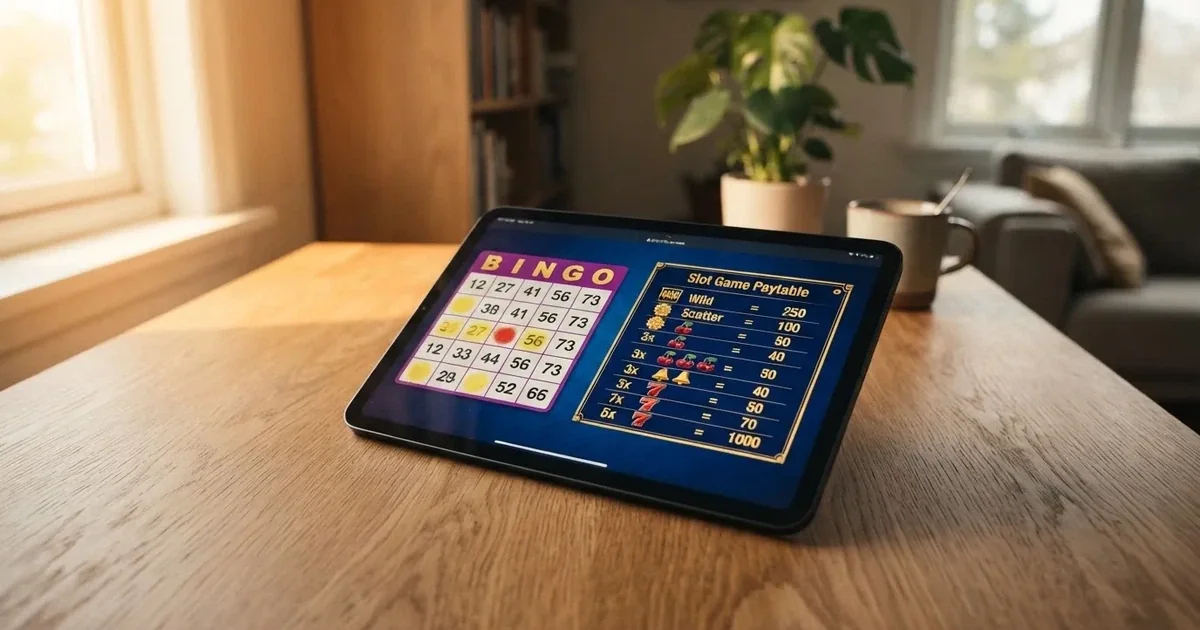
A slots paytable at a bingo casino looks the same as a paytable at any other online casino: the symbol values, the paylines, the bonus features, the RTP, the volatility. Two points matter in the read. First, the RTP is the long-run return to the player, not a guarantee on any spin; a 96 per cent RTP slot returns £96 of every £100 wagered over a long enough sample, and on any given session the result is determined by variance. Second, the volatility — a measure of how spread out the wins are around the RTP — decides the feel of the session more than the RTP does. A high-volatility slot pays less often in smaller amounts and more rarely in larger ones; a low-volatility slot pays more often in smaller amounts and rarely in larger ones. The same RTP can feel like two different games at two different volatilities.
A paytable that names a fixed jackpot is a paytable that ties the largest payout to a single combination; a paytable that names a progressive jackpot ties the largest payout to a pooled contribution across multiple casinos. The pooled version pays more rarely because the pool is shared; the fixed version pays more often because the prize is capped at the operator’s own contribution. Neither shape changes the RTP calculation; both change the player’s experience of waiting for a payout.
The licensed shortlist, side by side
The table below sets the ten GB-licensed brands in this comparison side by side on the figures that matter most. The licence holder is the company that holds the Gambling Commission remote casino operating licence; the licence number is the string on the Commission’s public register; the domain status records whether the player-facing site is an Active domain of the licence holder or a White Label domain that trades under the licence. The subject support column records the brand’s relationship to bingo specifically, where the research turns one up; where the register or the operator’s terms page carries no bingo-specific signal for that brand, the cell is left as the no-data marker rather than guessed at.
| Brand | Licence holder and GB remote casino licence | Domain status on the register | Bingo and slots support |
|---|---|---|---|
| Paddy Power | PPB Games Limited, 039411-R-319335-010 | Active | — |
| kwiff | Eaton Gate Gaming Limited, 044448-R-323408-017 | Active | — |
| Betway | Betway Limited, 039372-R-319367-029 | Active | — |
| bet365 | Hillside (UK Gaming) ENC, 055149-R-331499-004 | Active | — |
| Unibet | Platinum Gaming Limited, 045322-R-324275-019 | Active | — |
| 888casino | 888 UK Limited, 039028-R-319297-014 | Active | — |
| Virgin Games | Gamesys Operations Limited, 038905-R-319430-022 | White Label | — |
| Midnite | Dribble Media Limited, 042647-R-321653-022 | Active | — |
| Betfred | Petfre (Gibraltar) Limited, 039544-R-319290-010 | Active | — |
| BetVictor | BV Gaming Limited, 039576-R-319370-028 | Active | — |
The pattern across the table is the structural one: every brand sits on a GB-licensed operator, every licence number is searchable on the Commission’s public register, and the licence holders are the companies a player would direct any complaint to, not the brand on the door. Virgin Games is the only white-label domain in the set; the brand is owned and run for shareholders by Gamesys Operations Limited, which holds the underlying licence, and a player who needs to escalate beyond the brand’s own complaints process does so to the licence holder, not to Virgin Games’ corporate owner in the narrow sense. The rest are active domains of the licence holder that runs them.
The column gaps matter as much as the cells. The register does not record a brand’s product mix; it records only who is licensed to operate the domain. A player who wants to know whether Paddy Power, or kwiff, or BetVictor offers a 90-ball bingo room with a slot library underneath it is reading past the licence information into the brand’s own product page, where the offer changes more often than the licence does. The ten brands in the table are the universe the page can compare on licence; the product comparison runs from there.
Reading the comparison
Three points the table does not show. First, several brands in the set share a corporate parent at the licence-holder level — Ladbrokes, Coral and Gala Bingo all sit under LC International Limited, for instance — and the licence-holder entry is the unit the Commission registers, not the brand the player sees on the door. A player who treats the table as ten independent companies has read it for what it is not. Second, the licence number is not a quality mark; it is a permission. The Commission’s register does not rank its licence holders, and the licence number does not measure game quality, payout speed, or bonus generosity. Third, the white-label status of Virgin Games is a structural fact about the brand, not a comment on its reliability: Gamesys Operations Limited is the licence holder, the platform behind the lobby, and the route for any escalated complaint.
Operator write-ups
Each write-up below covers a single brand from the licensed set, in the order the plan fixes. The depth is the same across the ten: the licence line is fixed by the register, the product mix is described only where the brand’s own terms page names it, the verdict at the foot of each block answers a different question from the one before. The comparison at the head of the section is the frame; the write-ups are the detail.
Paddy Power
Paddy Power is an Active domain of PPB Games Limited, which holds remote casino operating licence 039411-R-319335-010 on the Commission’s register. The brand is one of the longest-running names in UK betting, and the licence sits at the heart of a group whose other Active domains the register also records. The licence-holder structure means the player who needs to complain beyond the brand’s own process goes to PPB Games Limited, not to Paddy Power’s parent group in the wider sense.
The product mix at Paddy Power is the wider group offer — sportsbook, casino, slots, a live-dealer section — and the bingo room is not the headline product the brand leads with. A player who arrives for a bingo-and-slots combination is one of several audiences the lobby is built for, and the bingo room’s prominence on the lobby reflects that. The bonus structure on the casino side adheres to the current UK standards: a 10x wagering cap applies since 19 December 2025, and the brand’s own terms specify eligible games and stake limits during bonus play. Mixed-product bonuses are not part of the current offer. The slots and live-dealer sections share the wallet, allowing bonus play across those categories, though bingo typically remains excluded from the eligible set.
The verdict highlights the brand’s multi-product strength: players seeking bingo alongside a developed sportsbook and slots library will find this account a solid choice. Those prioritizing a bingo-first experience might prefer a different lobby, as Paddy Power’s focus is clearly split across its diverse products.
kwiff
kwiff is an Active domain of Eaton Gate Gaming Limited, which holds remote casino operating licence 044448-R-323408-017. The licence-holder name is the entity a player escalates to, and the licence number can be verified via the Commission’s public records by the six-digit account number at the head of the string. kwiff’s product proposition is built around its “surprise bet” mechanic — a stake-by-stake randomisation of odds — and the casino product sits alongside that core.
The product mix on the casino side runs a slots library and a live-dealer section; the bingo room is not the brand’s lead product, and the lobby does not foreground it. Visitors seeking combined gaming options will find the slots library extensive, while the bingo room functions as a separate tab. Bonus terms are standardized here: a 10x wagering cap applies, mixed-product offers are excluded, and the operator clearly outlines eligible games and active-bonus stake limits.
The verdict assesses kwiff’s niche mechanic: users valuing the surprise-bet stake randomisation will find it a compelling addition to their casino experience. However, kwiff is likely less suited for dedicated bingo players seeking a room-first lobby, as the casino and betting features dominate the platform’s layout.
Betway
Betway is an Active domain of Betway Limited, which holds remote casino operating licence 039372-R-319367-029. The brand’s licence holder is the entity on the Commission’s register, and Betway Limited’s other Active domains the register also records. Betway is one of the longer-established names in the UK online casino market, with a product mix encompassing sports betting, casino games, and an extensive slots-and-live-dealer lobby.
The product mix on the casino side is a slots library and a live-dealer section; the bingo room is a smaller part of the lobby than at the brands that lead with it, and the brand’s primary marketing runs on the sportsbook and the wider casino product. Visitors looking for a mix of slots and live-dealer games will find this setup developed, with the bingo room accessible as a simple lobby tab. Bonus standards are consistent: a 10x wagering cap is enforced, mixed-product offers are not provided, and the operator’s terms specify eligible games and stake limits during bonus activity.
The verdict considers Betway’s market standing: players prioritizing a long-established licence holder and a robust slots-and-live-dealer library will likely appreciate the generalist approach here. If a bingo-centric lobby is your priority, however, you may find Betway’s emphasis on broader casino and sportsbook offerings less appealing.
bet365
bet365 is an Active domain of Hillside (UK Gaming) ENC, which holds remote casino operating licence 055149-R-331499-004. The licence holder is one of several Hillside entities on the Commission’s register, and the player-facing brand sits behind the ENC corporate structure. bet365 offers a comprehensive suite comprising sportsbook services, diverse casino games, and an engaging slots-and-live-dealer lobby, with a game-show section that has expanded the live-dealer category on the brand.
The casino product mix is expansive, featuring a slots library, live-dealer games, and game-show-style products, with a smaller bingo room integrated as a lobby tab. Those seeking varied slots and live-dealer titles will find this setup highly developed. Regarding bonus standards, a 10x wagering cap is in effect, mixed-product offers are not present, and the brand provides a detailed terms page outlining eligible games and stake limits during bonus play.
The verdict reflects the brand’s scale: those who enjoy expansive slots and live-dealer options will likely find bet365’s variety a significant asset. Conversely, players hunting specifically for a bingo-focused lobby may find the primary marketing focus on sports and broader casino products less aligned with their preferences.
Unibet
Unibet is an Active domain of Platinum Gaming Limited, which holds remote casino operating licence 045322-R-324275-019. The licence holder is the entity a player escalates to, and the licence number is searchable on the Commission’s public register. Unibet’s product proposition is built around the wider Kindred Group shape — sportsbook, casino, poker, bingo — and the Unibet brand has historically been one of the more bingo-active names in the wider European market.
The casino mix features a slots library, live-dealer section, and an integrated bingo room. Players who enjoy bingo will find this one of the more developed rooms in our list, with slots sitting conveniently on the same account wallet. Bonus terms follow standard industry protocols: a 10x wagering cap is active, mixed-product deals are excluded, and the operator’s terms specify eligible game contributions and active-bonus stake rules. This brand’s history with bingo is the structural reason the UK lobby offers a more developed room than many peers.
The verdict evaluates Unibet’s bingo depth: those desiring a bingo room that operates as a core component rather than a simple lobby tab will find this a strong candidate, with a slots library conveniently accessible via the same wallet. Players whose primary focus is slots with occasional bingo will also find this platform highly adaptable.
888casino
888casino is an Active domain of 888 UK Limited, which holds remote casino operating licence 039028-R-319297-014. The licence holder is one of several 888 entities on the Commission’s register, and the player-facing brand sits behind 888 UK Limited’s licence. 888casino’s product proposition is built around the slots library and the live-dealer section, with the brand’s proprietary platform running a meaningful share of the games on the lobby.
The casino mix prioritizes a slots library and live-dealer section, while a smaller bingo room is offered as a lobby tab. Players who prefer a slot-dominated experience will find the games list extensive, though the bingo room serves a secondary role. Bonus terms are standard: a 10x wagering cap applies, mixed-product offers are unavailable, and the operator’s terms detail eligible game contributions and stake limits. The proprietary platform means games are sourced from both in-house teams and external providers, with section-specific variances.
The verdict considers 888casino’s slots expertise: enthusiasts of deep slots libraries and proprietary gaming platforms will find this brand’s focus well-tailored. Players prioritizing a bingo-led product, however, may find the bingo room’s status as a minor lobby feature less satisfying than other alternatives.
Virgin Games
Virgin Games is a White Label domain of Gamesys Operations Limited, which holds remote casino operating licence 038905-R-319430-022. The white-label status means Virgin Games is not itself the licence holder; Gamesys Operations Limited is, and a player who needs to escalate beyond the brand’s own complaints process goes to Gamesys Operations Limited. The structural difference from the Active-domain brands in the set is the corporate layer between the brand on the door and the licence holder behind it.
The casino product mix includes a slots library alongside a bingo room integrated with the casino offering. Gamesys Operations, an established name in UK bingo, provides the bingo platform, which is reflected in the lobby’s layout. Players will find the bingo room among the most developed in our shortlist, with slots conveniently available on the same wallet. Bonus terms are standard: a 10x wagering cap is enforced, mixed-product offers are not provided, and the operator specifies terms for eligible games and stake limits during bonus play.
The verdict reflects on the brand’s structural position: Virgin Games stands out as the comparison’s only white-label domain. Players who value transparency regarding the licence holder—the entity responsible for escalations—will find this information clearly accessible. The balanced product mix provides a solid option for those enjoying both bingo and slots.
Midnite
Midnite is an Active domain of Dribble Media Limited, which holds remote casino operating licence 042647-R-321653-022. The licence holder is a smaller entity in the licensed set by reference to the wider Commission’s register, and the player-facing brand is one of the more recently-launched in the comparison. The brand features a diverse portfolio including sports betting, casino games, and a slots-led lobby, with the bingo room serving as a smaller part of the mix.
The casino mix focuses on a slots library and live-dealer section; the bingo room is a lobby tab rather than a core focus. Visitors seeking integrated gaming options will find the slots library developed, while the bingo room remains a secondary feature compared to bingo-centric brands. Bonus terms are standard: a 10x wagering cap applies, mixed-product offers are unavailable, and the operator’s terms specify eligible games and stake limits for bonus play.
The verdict regarding Midnite’s market entry is straightforward: those favoring a newer operator with a strong slot focus will find this brand a compelling choice. While the bingo room is present as a lobby tab, the brand’s primary energy remains centered on its slots and sports products.
Betfred
Betfred is an Active domain of Petfre (Gibraltar) Limited, which holds remote casino operating licence 039544-R-319290-010. The licence holder sits in Gibraltar, which is the structural reason for the corporate name; the licence itself is a Gambling Commission remote casino operating licence, and the brand is subject to the same UK rules as any other GB-licensed operator. Betfred provides a full array of services covering sportsbook, casino, and an extensive slots-and-live-dealer lobby, with a bingo room that sits as a tab on the wider product.
The mix includes a slots library, a live-dealer section, and an integrated bingo room available as a lobby tab. Visitors looking for a variety of slot and live-dealer games will find the selection well-developed, while the bingo room remains one of several navigation options. Bonus rules are standardized: a 10x wagering cap is in place, mixed-product offers are not provided, and the operator’s terms detail eligible game contributions and stake limits during bonus play.
Betfred’s verdict reflects its status as a veteran multi-product operator: if you appreciate an established licence holder and a broad range of developed slots and live-dealer games, the bingo room serves as a functional companion. However, players specifically seeking a bingo-first experience might find the brand’s heavy marketing emphasis on sports more prominent.
BetVictor
BetVictor is an Active domain of BV Gaming Limited, which holds remote casino operating licence 039576-R-319370-028. The licence holder is the entity a player escalates to, and the licence number is searchable on the Commission’s public register. BetVictor maintains a robust catalogue encompassing sportsbook, casino, and an expansive slots-and-live-dealer lobby, with the brand’s wider history in UK betting the structural reason for the multi-product shape.
The product mix on the casino side runs a slots library and a live-dealer section; the bingo room is a smaller part of the lobby than at the bingo-led brands in the set, and the brand’s primary marketing runs on the sportsbook. A player who arrives for a combined bingo-and-slots experience will find the slots library developed and the bingo room a tab on the lobby rather than a featured section. The bonus structure follows the wider UK pattern: a 10x wagering cap, no mixed-product bonuses, the operator’s own terms naming the eligible games and the stake cap.
BetVictor’s verdict highlights its balanced, multi-product approach: it remains a reliable choice for players who value an established sportsbook-and-casino brand where bingo functions as a helpful lobby addition. Conversely, those seeking a dedicated bingo-first environment may find the focus on sports and casino games leaves the bingo room feeling secondary.
Frequently asked questions
What is the difference between a bingo room and a bingo-linked slot?
A bingo room is a 90-ball (or 75-ball, or 80-ball) game governed by the equal-chance rule: every player has the same chance of winning, no player plays against the bank, and the room’s prize structure is fixed by the operator before the game starts. A bingo-linked slot is a slot game themed around bingo — the reels carry bingo numbers, the bonus feature triggers a simulated bingo card — but the mathematics is a slot’s: a random outcome per spin, an RTP and a volatility profile, a stake per spin bound by the £5 / £2 slot caps. The two products look similar on the lobby and behave very differently underneath.
Are there bingo slots available with no deposit required to try?
Yes — most GB-licensed brands offer a no-deposit bonus or a free-play mode on at least part of the slots library, and a few offer a no-deposit bonus that includes the bingo room. The Commission’s rules still apply: identity must be verified before any play, GAMSTOP must be honoured, and the no-deposit offer carries its own terms — wagering requirements, time limits, eligible games, max cashout — that the player should read before claiming. A no-deposit offer is not free money; it is a bonus with strings attached, and the strings are usually tighter than the strings on a deposit-gated bonus.
What wagering terms usually apply to a bingo site’s slots bonus?
Since 19 December 2025 wagering requirements have been capped at 10x. That ceiling sits on top of the operator’s own terms: the eligible games list, the stake cap while the bonus is active, the time limit, the game-weighting rule, and any max-cashout clause. A 10x bonus with a tight eligible-games list and a short time limit is a different offer from a 10x bonus with a wide eligible-games list and a longer time limit; the headline number is the same. A player who reads only the headline and the wagering number has read half the offer.
Is there a dedicated app for bingo casinos, or only a browser site?
Both. Most GB-licensed operators run a browser site that works on phone and tablet, and a meaningful minority run a native app on top. The app and the browser site call the same backend, run the same RNG, honour the same GAMSTOP state, and verify identity at the same point; the differences are about push notifications, lobby speed from the home screen, and the path to a fresh deposit. A player who already has a deposit method set up at the brand gets the same experience in either channel; the choice is about which channel they prefer, not about what each channel offers.
How is a bingo casino’s payout speed compared with a standard slots site?
The payout speed at a GB-licensed bingo casino is set by the operator’s own SLA and by the payment method, not by the Commission. A same-method-as-deposit policy applies at every GB-licensed operator: the brand returns money to the card or e-wallet it came from, and a player who wants to withdraw to a different method has to send the funds back to the original source first. A clean withdrawal takes hours; a withdrawal that retriggers identity verification can take days. The Commission’s role is to make sure the operator runs the necessary checks; the speed at which those checks complete is the operator’s choice.
Must a bingo casino be licensed by the Gambling Commission to accept UK players?
Yes. Under the Gambling Act 2005 and the Gambling (Licensing and Advertising) Act 2014, any operator taking customers in Great Britain needs a Gambling Commission licence, wherever the operator itself is based. A Curaçao, Maltese or Gibraltar licence on its own is not a substitute for a GB licence. A player at an unlicensed site has no GAMSTOP, no Commission complaints route, and no approved ADR — the protection the GB licence buys the player simply does not exist offshore. The Commission’s register is the test of whether a brand is licensed, and the licence number is the string a player can paste into the search box and verify in under a minute.
Written by the editors at lowdepositcasinouk.