
Best 3-Reel Slots in the UK for 2026: How the Classics Actually Work, and Where You Can Still Spin Them
 Available in GB
Data current as of 23 September 2026, verified against the Gambling Commission’s public register of gambling businesses.
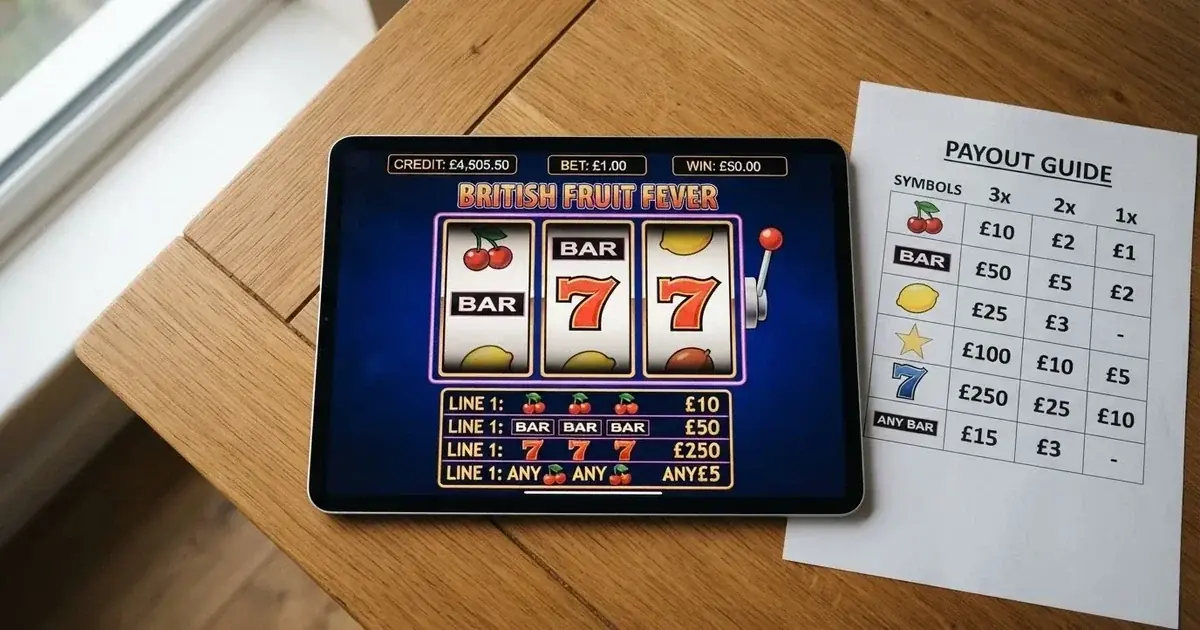
Three reels, one payline, a row of cherries and a single bell. That is the shape most of us picture when someone says “slot machine”. The form has not been pushed off UK casino floors or out of UK casino lobbies — it has just moved sideways into a different part of the screen, and into a part of the market where the older rules still apply. The mechanics are old enough to be simple, the regulation is new enough to matter, and the difference between a real-money spin and a free one is bigger than the word “free” suggests.
This page reads the mechanics, the licences and the offers the way they actually sit in the UK market right now. It does not advertise any operator, list any bonus code, or recommend where to play. Where a piece of the picture is missing, that is named plainly. Where a number decides something, that number is named plainly too.
Table of Contents
- Demo Play and What “No Registration” Actually Means in the UK
- How Money Actually Moves Through a 3-Reel Slot in the UK
- The Payout Question, Answered in Bands Rather Than One Number
- Wagering Rules and the 10x Cap That Repriced UK Bonuses
- What the UK Licence Actually Guarantees, and What It Doesn’t
- How the Regulated Floor Translates Into a Player’s Day
- Why GAMSTOP Matters More for the Casual Player Than the Heavy One
- Side-by-Side: Where the Licence and the Catalogue Sit Right Now
- Paddy Power
- Unibet
- Sky Vegas
- kwiff
- bet365
- MrQ
- Midnite
- Virgin Games
- BetVictor
- Grosvenor Casinos
- The Wider Shape of the UK Slot Market, for Context
- Tax, Withdrawals and What the Operator Keeps
- The Player’s Checklist, in the Order It Actually Happens
- What a 3-Reel Slot Costs, in the Arithmetic a Player Can Actually Do
- What “Best” Means in a Market Where Every Operator Is Licensed
- What This Page Is Not
- Frequently Asked Questions
Demo Play and What “No Registration” Actually Means in the UK
A player who searches for a 3-reel slot has usually just decided they want the simpler game. The first thing the search results offer is a free version, often with the word “no registration” sitting next to it. That promise is half-true and worth reading carefully, because the half that is true and the half that is not belong to different products.

A no-registration demo is a real thing. Studios and review sites host playable versions of their games on a public page: the reels spin, the paytable is visible, the bonus rounds trigger. No account is created, no money changes hands, no identity document is asked for. It is the closest thing in online gambling to kicking a tyre, and it is genuinely useful for learning a game’s payout structure before any cash is on the line. Most major studios — NetEnt, Microgaming, Play’n GO, Pragmatic Play among them — make these demo builds available, and the slot review sites that index them usually embed the same demos without alteration.
The half that is not true is the part a UK player most needs to hear: this is how free play works, and only this. The moment real money is on the line, the same studio’s game sits behind a different door, and the door is run by a Gambling Commission licensee. Since 7 May 2019, that licensee has been required to verify name, address and date of birth before the first deposit or any play. Anonymous real-money play at a GB-licensed site is not available, because the regulator does not permit it. A player can demo a slot in ten seconds and never give a name; the same player cannot deposit a pound at a licensed site without giving one.
The boundary matters because the marketing does not always draw it. A page that says “play 3-reel slots no registration” is describing the demo. A page that says “play 3-reel slots for real money no registration” is describing something that does not exist in the regulated UK market, and the search results are full of both shapes of sentence. The first is a useful tool. The second is a promise that ends, in practice, at one of three places: a site without a Gambling Commission licence (and therefore without the protections that licence requires), a site that takes the deposit and runs the verification at withdrawal, or a misread of the demo offer as a real-money offer.
For a player who wants the game without the paperwork, the demo is the answer. For a player who wants the chance to win money, the registration is unavoidable.
How Money Actually Moves Through a 3-Reel Slot in the UK
Three-reel slots are the original slot format, and they have not changed much because the format does not need to. A spin sets three reels spinning, each reel is divided into a fixed number of stops, and a payline — usually the horizontal line through the middle — decides the outcome. The number of stops per reel, the symbols on each stop, and the payout for each combination are the three things the paytable tells a player.

The earliest mechanical version, Charles Fey’s Liberty Bell, paid ten nickels — fifty cents — for three aligned bells. That was the game’s first real-money payout in 1899. The format repeated quickly. Herbert Mills produced the first Liberty Bell copy in 1907, and the three-reel machine became the standard fixture of American and European gaming halls through the middle of the twentieth century. Sittman and Pitt of Brooklyn had built a five-drum poker-based machine as early as 1893, but it had no automatic payout, which is why the Liberty Bell, with its three reels and its self-paying mechanism, is the design that stuck.
Modern 3-reel online slots still look like the Liberty Bell on the surface. Underneath, they are governed by a different mechanism entirely. In 1984, the Norwegian mathematician Inge Telnaes patented the use of a random number generator to pick reel-stop positions, which let manufacturers weight symbol probabilities independently of the physical reel layout. A three-reel slot can show the same three symbols on its visible reels and still produce a different return-to-player than the version sitting beside it, because the weighting is in software rather than in the metal stops. The visible reel is, in a real sense, a picture of a probability table.
That mechanism is what makes payout rates worth comparing. The paytable tells the player what each combination pays when it lands. The theoretical return-to-player, or RTP, tells the player what fraction of all money wagered the game is programmed to return over a long run. In the UK, remote gambling operators are required to monitor ongoing RTP performance against the advertised figure and to flag any game that drifts outside an acceptable range; the Gambling Commission treats confirmed RTP errors as key events and reviews the monitoring process during annual games testing audits. The advertised figure is not just a marketing line — it is a number the operator has to defend.
Volatility describes a different thing, and a player reading a paytable should keep the two apart. Volatility is the risk profile of the game: a low-volatility slot pays out smaller wins more often, a high-volatility slot pays out less often but more. RTP is the long-run average; volatility is the shape of the ride around that average. A low-volatility 3-reel slot and a high-volatility 3-reel slot with the same 96% RTP will look very different to a player across any session short enough to feel.
The UK regulator also sets a minimum time on each spin and a maximum on what the spin can cost. Online slots may not run faster than 2.5 seconds per spin, and reverse withdrawals — a request to put money back into play after a player has asked for it out — were banned from 31 October 2021. The £2 / £5 stake limit, the spin-speed floor and the auto-play ban are all part of the same design: a slot spin in the UK is supposed to take long enough and cost enough that the player notices both.
The Payout Question, Answered in Bands Rather Than One Number
“What payout can I expect?” is the question every slot review eventually meets, and the honest answer is a band rather than a single percentage. The typical 3-reel online slot advertises a theoretical RTP in the mid-90s, with most titles in the licensed UK market sitting between 94% and 97%. Outside that band, the picture is uneven: a small number of older or specialty titles fall lower, and a small number of high-payout releases sit closer to the upper edge. The question “which 3-reel slots have the highest payout rates” does not have a clean league-table answer, because every operator hosts a different catalogue and not every operator publishes the same figure for the same title.
The only reliable answer for a UK player is the one on the paytable of the game in front of them. Two slots with similar names can carry different RTPs at different sites, and the regulator’s monitoring requirement exists precisely because that gap is real and worth checking. A player who wants the highest payout available at their site of choice should read the paytable, not a review article, because the paytable is the only number the operator has committed to defend.
Volatility is the second thing to weigh, and the one most often skipped. A 96% RTP slot played at high volatility will produce long dry stretches punctuated by larger wins; the same RTP at low volatility will produce shorter dry stretches and smaller wins. A player with a small bankroll tends to do better on the low-volatility shape, because the bankroll survives long enough to meet the advertised average. A player chasing a big payout tends to prefer the high-volatility shape, because that is where the bigger payouts live. The two are not interchangeable, and “high payout 3-reel slots” is a phrase that usually means high volatility rather than high RTP.
For the UK player, there is also a national ceiling to keep in mind. The maximum stake per game cycle is £5 for players aged 25 and over (from 9 April 2025) and £2 for players aged 18 to 24 (from 21 May 2025). That ceiling is set by the Gambling Commission and applies to every GB-licensed operator. The advertised RTP and volatility describe how the game behaves; the stake ceiling describes how much each spin can cost. Both are part of what a player is actually buying.
Wagering Rules and the 10x Cap That Repriced UK Bonuses
Until 19 December 2025, UK bonuses carried whatever wagering requirement the operator wrote into the small print. Some required the bonus to be turned over thirty or forty times before any withdrawal; some split the requirement across the deposit and the bonus; some applied the requirement only to winnings. The shape varied because the rules allowed it to vary. That changed on 19 December 2025, when the Gambling Commission’s new rules came into force: wagering requirements on casino bonuses are now capped at 10x, and mixed-product bonuses — the kind that give a player casino spins in return for a sports bet — are banned.
The 10x cap is the single biggest pricing change the UK bonus market has seen in years, and the easiest way to see what it actually costs a player is to run the arithmetic. A £100 bonus with a 10x wagering requirement means £1,000 of qualifying turnover before withdrawal. At a £1 stake per spin on a 96% RTP 3-reel slot, that is 1,000 spins. At the regulator’s 2.5-second minimum spin time, those 1,000 spins take 2,500 seconds — roughly 42 minutes of uninterrupted play. A £500 bonus with the same cap means £5,000 of turnover, 5,000 spins, and just over three and a half hours of play. The relationship is linear, and the line is what the 10x cap drew.
The honest reading of that line is that the cap does not kill the bonus; it taxes it differently. A bonus whose wagering requirement used to be 35x is now constrained to 10x, which means the bonus either gets smaller (so the operator’s exposure is smaller) or the structure of the offer changes (so the player sees something other than a deposit match, such as free spins at a fixed value, or a cashback offer with no wagering requirement at all). Both shapes are appearing in the UK market since the cap came in.
The second rule — no mixed-product bonuses — closes a door that was already producing complaints. A free-spin package that landed in a sportsbook account, or a sports free bet that turned into casino credit, was a kind of bonus that the player could not always price before claiming. The ban does not mean offers have disappeared; it means the offer a player sees at a casino is now a casino offer, and the offer they see at a sportsbook is a sportsbook offer.
The stake and the slot together set the cost of clearing a bonus. At the £2 stake ceiling for an 18-24-year-old, the same £1,000 of turnover takes 500 spins at minimum spin time — but those 500 spins each cost less, which leaves the wagering turnover unchanged. The 10x cap is on the multiple, not on the time, and a younger player with the same bonus will see fewer pounds at risk per spin but the same number of qualifying bets to clear.
What the UK Licence Actually Guarantees, and What It Doesn’t
A Gambling Commission licence is the only thing that lets an operator take real-money play from players in Great Britain. Since the Gambling (Licensing and Advertising) Act 2014, the licence requirement applies wherever the operator is based — a Curaçao, Maltese or Gibraltar licence is not a substitute, and an operator offering play to UK customers without a Commission licence commits an offence under section 33 of the Gambling Act 2005. The Commission maintains a public register of every licensed operator, and the register is searchable online and downloadable as a CSV. As of 18 September 2026, it held 139 businesses with an active remote casino operating licence.
The register does more than confirm that a brand is licensed. It ties each website to the licence account that runs it, with a status of Active, Inactive or White Label. On 18 September 2026 the register’s domain list held 1,065 active and 361 white-label entries. A white-label site is one that trades under another company’s licence — the brand on the homepage is a marketing layer, the operating licence behind it belongs to a different company. Virgin Games, for example, is a white-label domain of account 38905, Gamesys Operations Limited; the operator of record is Gamesys, not the brand on the screen. That distinction is not a problem in itself — many well-run UK sites are white-labels — but it is information a player is entitled to know, because the complaint route and the regulatory contact run to the licensee, not the front-of-house brand.
A licence number on the register has a fixed shape: it reads account-R-number-suffix. The leading six digits repeat the licence holder’s account number, and the “R” marks a remote (online) licence. Paddy Power, for instance, sits under account 39411 with the licence 039411-R-319335-010, held by PPB Games Limited. The format is not decorative — it lets a player match the brand on the page to the entry on the register in a few seconds.
What the licence guarantees is a defined floor of conduct: identity verification at sign-up, segregated player funds, GAMSTOP participation, monitoring of game RTP, complaints routed through an approved alternative dispute resolution provider, and a Commission that can revoke the licence if the floor is breached. What it does not guarantee is a particular game’s payout rate, a particular bonus size, or a particular withdrawal time — those vary between operators and are set by the operator’s own terms.
What it also does not guarantee is a refund for someone who played at an unlicensed site. The Commission disrupts illegal sites through cease-and-desist notices, search-engine delisting and referrals to payment and hosting providers, but it does not have the power to block internet service providers, and there is no penalty aimed at the player. The cost of unlicensed play falls on the player: no GAMSTOP self-exclusion, no Commission complaints route, no approved ADR, no guarantee that a withdrawal request will be honoured at all.
How the Regulated Floor Translates Into a Player’s Day
The licence is the background; the rules that touch a session are the foreground. A UK player opening an account at a licensed site today goes through the same onboarding pattern every operator is required to follow. Name, address and date of birth are verified before the first deposit or any play. From 31 October 2025 the operator has to prompt the customer to set a financial limit before that first deposit — not impose one, but ask. From 28 February 2025 a financial vulnerability check runs at £150 net deposits in a rolling 30-day window using public data. None of these checks is optional at a licensed site, because the licence is the licence to operate.
The slots themselves sit under the same package of rules. Auto-play is banned. Spin speed may not fall below 2.5 seconds. Losses disguised as wins are banned — a sound effect or animation that celebrates a net loss on a spin can no longer be deployed. Reverse withdrawals, which let a player put money back into play after asking to take it out, were banned from 31 October 2021. The 10x wagering cap and the mixed-product ban took effect on 19 December 2025. The £5 / £2 stake ceiling for adults aged 25+ / 18-24 took effect on 9 April 2025 and 21 May 2025 respectively.
What the package adds up to is a slower, smaller, more legible spin than the one the same games offer in less-regulated markets. The 2.5-second floor means a thousand spins takes 42 minutes at minimum, not the four or five minutes a faster-regulated market might allow. The £2 / £5 ceiling caps the size of any single decision. The wagering cap puts a hard ceiling on how much a bonus can demand before withdrawal. The financial vulnerability check puts a soft ceiling on how much can go in before the operator is required to ask a question.
The reason the package reads as one design is that it is one design. The Gambling Commission published it as a coordinated set of changes, and the rationale the UK government gave for the lower £2 stake limit for 18-24-year-olds was the age group’s highest average problem gambling score, lower disposable income and ongoing neurological development. Each rule alone is a restriction; together they are an attempt to put a floor under how fast, how much and how invisibly a player can lose.
Why GAMSTOP Matters More for the Casual Player Than the Heavy One
Self-exclusion is one of the few interventions that works most clearly for the player who would otherwise never look for it. GAMSTOP is the national online self-exclusion scheme, and it has been a mandatory condition of every online licence since 31 March 2020. A player who signs up for GAMSTOP chooses a six-month, one-year or five-year exclusion period, and the choice cannot be cancelled early. Every GB-licensed online operator is required to check new sign-ups against GAMSTOP and to refuse registration to anyone on the list.
The practical effect is that a single GAMSTOP registration blocks new account creation across every GB-licensed site for the chosen period. A player who wants to stop does not have to remember which operators they have accounts at, or chase account closures one at a time. The block applies across the regulated market in one step.
The reason this matters for a player browsing 3-reel slots is that the games themselves are a high-frequency, low-decision product. Three reels, one payline, a spin every few seconds — the format is built for repetition, which is part of why it has survived. Repetition is also what makes self-exclusion most useful, because the path from “one more spin” to “I should not have done that” is shorter on a 3-reel slot than on most other casino products. The national helpline is GamCare, with the National Gambling Helpline run by the same organisation. GambleAware funds treatment and research across Great Britain. None of these is a substitute for the GAMSTOP block, but they sit beside it as the support layer that the licensed market is required to fund.
The other piece of the responsible-gaming floor is financial. From 31 October 2025 operators must prompt the customer to set a deposit limit before the first deposit — the customer can decline, but the prompt is mandatory. From 28 February 2025 a financial vulnerability check runs at £150 net deposits within a rolling 30-day window using public data only; broader financial risk assessments have been announced but are not yet in force. The licensed market’s responsible-gaming framework is therefore a stack: GAMSTOP for the heaviest cases, a deposit prompt for the lightest, and financial vulnerability checks for the middle. A 3-reel slot session at a licensed site sits inside all of it.
Side-by-Side: Where the Licence and the Catalogue Sit Right Now
The table below is a snapshot of the operator side of the UK 3-reel market — licence holder, licence number, domain status on the register, and whether the operator carries any specific subject support for 3-reel slots beyond what every GB-licensed casino offers. The figures are taken from the Gambling Commission’s public register of gambling businesses as of 18 September 2026. Where the operator carries no specific subject support, that column is empty rather than a denial; every GB-licensed operator must offer some form of slot play, and a 3-reel title is almost always part of that catalogue.
| Brand | Licence holder and GB remote casino licence | Domain status on the register | Subject support |
|---|---|---|---|
| Paddy Power | PPB Games Limited · 039411-R-319335-010 | Active | — |
| Unibet | Platinum Gaming Limited · 045322-R-324275-019 | Active | — |
| Sky Vegas | Bonne Terre Gaming Limited · 065519-R-339675-002 | Active | — |
| kwiff | Eaton Gate Gaming Limited · 044448-R-323408-017 | Active | — |
| bet365 | Hillside (UK Gaming) ENC · 055149-R-331499-004 | Active | — |
| MrQ | Tek Fox Ltd · 060629-R-337532-004 | Active | — |
| Midnite | Dribble Media Limited · 042647-R-321653-022 | Active | — |
| Virgin Games | Gamesys Operations Limited · 038905-R-319430-022 | White Label | — |
| BetVictor | BV Gaming Limited · 039576-R-319370-028 | Active | — |
| Grosvenor Casinos | Rank Interactive (Gibraltar) Limited · 057924-R-334666-005 | Active | — |
The shared pattern across the table is that every brand sits under a GB-licensed operating company, the licence number follows the Commission’s standard format, and the domain status is almost always Active. The one white-label entry — Virgin Games, trading under Gamesys Operations Limited — is a structural fact about how that brand is operated, not a flag about its quality. What the table does not show, and what the public register does not break down by title, is which 3-reel games each operator currently hosts. That information sits on each operator’s own lobby, not on the regulator’s register, and it changes with the catalogue.
What the table does make easy to see is the licence-difference between brands, which for the GB market is none: every brand is licensed by the same regulator, against the same rules, with the same player-protection framework. The practical differences between operators sit in catalogue, bonus structure, withdrawal time and user experience — areas the register does not adjudicate.
Paddy Power
Paddy Power trades under PPB Games Limited, and the licence number on the Gambling Commission’s public register is 039411-R-319335-010, with Paddy Power listed as an active domain of account 39411. The operator is a well-known high-street and online bookmaker with a casino attached, and the casino lobby carries a typical mix of 3-reel and 5-reel slots from major studios. The licence and the domain status are the two facts the register settles; the catalogue sits on the operator’s own site and changes as titles are added or retired.
The subject-specific question — what does Paddy Power offer a 3-reel slot player that another licensed site does not — is not something the public register answers, and no operator-specific catalogue claim is made here on the operator’s behalf. For a player browsing 3-reel slots, what the licence guarantees is the floor: the same GAMSTOP block, the same age-verification process, the same 2.5-second spin floor, the same £2 / £5 stake ceiling, and the same complaints route. The catalogue above that floor is the operator’s own.
Unibet
Unibet trades under Platinum Gaming Limited, account 45322, with the remote casino licence 045322-R-324275-019 and unibet.co.uk listed as an active domain. Unibet is part of the Kindred Group and has carried a casino product in the UK for years; the casino lobby is a full-size offering rather than a sportsbook attachment. The licence number on the register is what a player can match against the entry to confirm the brand is being operated by the named licensee, which matters because white-label arrangements elsewhere in the market can make that match less obvious.
For 3-reel slot play specifically, the catalogue is the operator’s own business; the page does not make a claim about which 3-reel titles Unibet currently hosts. What the licence entry confirms is that the brand sits under a GB-licensed operator against the standard 10x wagering cap and the standard player-protection framework. Anything beyond that — withdrawal speed, bonus offers, particular game studios — is governed by Unibet’s own terms.
Sky Vegas
Sky Vegas trades under Bonne Terre Gaming Limited, account 65519, with the licence 065519-R-339675-002 and Sky Vegas listed as an active domain. Sky Vegas is the casino arm of the Sky brand, and the product has run as a standalone casino rather than a sportsbook-with-casino. This licence and domain status were confirmed on 18 September 2026.
The 3-reel slot question — which titles, what RTPs, what bonus terms — is not answered by the public register, and no claim is made here about Sky Vegas’s specific catalogue. The licence entry confirms the regulated floor; the catalogue above that floor is on the operator’s site and changes over time.
kwiff
kwiff trades under Eaton Gate Gaming Limited, account 44448, with the licence 044448-R-323408-017 and Kwiff.com listed as an active domain. kwiff has positioned itself as a smaller, more product-led operator in the UK market, and its casino lobby is the smaller side of the licence’s scope. The licence number is on the standard format, and the domain is active.
No claim is made here about kwiff’s specific 3-reel catalogue. The public register confirms the licensed status; the operator’s site is the source for catalogue details. A player who wants to know whether kwiff hosts a particular 3-reel title has to look at the lobby, not the register.
bet365
bet365 trades under Hillside (UK Gaming) ENC, account 55149, with the licence 055149-R-331499-004 and Bet365.com listed as an active domain. bet365 is one of the largest operators in the UK market, with a casino product attached to a much larger sportsbook. The casino lobby carries a broad catalogue of slots, and 3-reel titles from major studios are typically part of that catalogue.
The licence entry confirms the regulated floor; the catalogue above that floor is on the operator’s own site. The register does not catalogue games, and no specific game-level claim is made here about bet365’s 3-reel offering. What the licence guarantees — GAMSTOP, age verification, the 2.5-second spin floor, the £2 / £5 stake ceiling, the 10x wagering cap — applies in the same way as it does at every other licensed site.
MrQ
MrQ trades under Tek Fox Ltd, account 60629, with the licence 060629-R-337532-004 and MrQ listed as an active domain. MrQ has marketed itself as a no-wagering-required casino, which sits cleanly inside the 10x wagering cap that came into force on 19 December 2025: a zero-wagering offer is below the cap, not in conflict with it. The register shows this licence and domain status.
For 3-reel slot play, MrQ’s catalogue is on the operator’s site. The public register confirms the licensed status; the offer structure sits above the register. A player who values no-wagering bonuses has to look at MrQ’s current terms directly, because the register does not record bonus design.
Midnite
Midnite trades under Dribble Media Limited, account 42647, with the licence 042647-R-321653-022 and Midnite listed as an active domain. Midnite is one of the newer entrants to the UK online casino market, and the product has been built as a sportsbook-led operator with a casino attached. The licence and domain data are verified on the register.
The 3-reel catalogue is on the operator’s own site. No specific catalogue claim is made here. The licence confirms the regulated floor, and the catalogue above it is Midnite’s to publish and the player’s to read.
Virgin Games
Virgin Games sits on the register as a white-label domain of account 38905, Gamesys Operations Limited, which holds the licence 038905-R-319430-022. A white-label arrangement means the brand on the homepage — Virgin Games — is operated by the named licensee, Gamesys. The regulatory contact, the complaints route and the licence obligations all run to Gamesys, not to the front-of-house brand. That is the standard arrangement for a white-label site in the UK, and it is not, in itself, a problem; it is information the register publishes and the player is entitled to know.
The 3-reel catalogue for Virgin Games is on the operator’s site. The licence confirms the regulated floor; the catalogue above it is the operator’s. A player who wants to confirm the operator of record can read the register directly.
BetVictor
BetVictor trades under BV Gaming Limited, account 39576, with the licence 039576-R-319370-028 and BetVictor listed as an active domain. BetVictor has run a casino product in the UK for years, alongside its sportsbook, and the casino lobby carries a typical mix of slot titles. The licence and status are verified on the public register.
The 3-reel catalogue is on the operator’s own site. The register confirms the regulated floor; the catalogue above it is BetVictor’s to publish.
Grosvenor Casinos
Grosvenor Casinos trades under Rank Interactive (Gibraltar) Limited, account 57924, with the licence 057924-R-334666-005 and Grosvenor Casinos listed as an active domain. Grosvenor is unusual in the UK market in that the brand also operates a chain of land-based casinos, and the online product sits beside that physical estate. The licence is held by the Gibraltar-based operating company, which is permitted under the Gambling (Licensing and Advertising) Act 2014 provided the operator holds a Commission licence, which it does.
The 3-reel catalogue is on the operator’s own site. The register confirms the regulated floor; the catalogue above it is Grosvenor’s to publish. The land-based estate does not change the licence entry; the licence entry governs the online product.
The Wider Shape of the UK Slot Market, for Context
Three-reel slots sit inside a wider market whose other products are worth knowing the names of, because the boundaries between them are not always obvious in marketing copy. Two products in particular get bundled with classic 3-reel slots in search results, and both deserve a moment of explanation.
Crash games, of which Aviator is the most widely cited example, are a multiplayer casino product developed by Spribe, a games studio founded in 2018. Aviator itself was released by Spribe in 2019 and has, by Spribe’s own reporting, more than 42 million active users and around 350,000 bets per minute across more than 5,000 operators worldwide. The format is not a slot: a multiplier curve rises from 1.00x until the round randomly crashes, and the player must cash out before the crash to win their stake multiplied by the current value. It is a separate game type with its own mathematics and its own regulatory treatment. A player who searches for “3-reel slots” and lands on an Aviator page has crossed a category boundary in the search results, not in the product.
Baccarat is the other boundary that comes up. Baccarat’s origins are disputed — some accounts trace it to 19th-century France, others to Italian soldiers at the end of the 15th century — and the modern Punto Banco variant, which is the form most widely played today, developed in Havana during the 1940s. In Punto Banco, the casino banks the game at all times and both hands are dealt out according to fixed drawing rules, so players make no strategic decisions. Chemin de Fer, the most popular baccarat variant in France, gives players strategic choices and includes an element of skill. None of this is a slot. A 3-reel slot is a one-player game against a random outcome; baccarat is a two-hand card game with a fixed drawing protocol. They share a casino floor and a regulator, but not a format.
The reason for naming both is that the search results around “best 3-reel slots UK” sometimes include pages that mention crash games or baccarat in the same breath, and the player who is browsing a 3-reel slot page wants to know whether those mentions belong to the same product. They do not. The slot product — whether 3-reel or 5-reel — is governed by the slot rules: 2.5-second spin floor, no auto-play, no losses disguised as wins, the £2 / £5 stake ceiling, and the operator’s RTP monitoring obligation. The other products carry their own rules.
Tax, Withdrawals and What the Operator Keeps
UK players pay no tax on gambling winnings. The operator pays Remote Gaming Duty, which the government raised from 21% to 40% from 1 April 2026 — a figure worth keeping in mind for the operator side of the market, because it changes what an operator can afford to give away in bonus value, but it does not change what a player keeps. A player who wins at a licensed site keeps the win, less any wagering-related deductions the bonus terms applied, and pays no tax on the balance.
Credit cards have been banned for gambling in the UK since 14 April 2020, including credit cards routed through e-wallets. That ban applies to deposits at every GB-licensed operator, and it is one of the few rules a player meets before any game is loaded. Reverse withdrawals — putting money back into play after asking for it out — were banned from 31 October 2021, which closes a door the operator used to be able to leave open.
What the licensed floor does not promise is a particular withdrawal time. Withdrawal speed varies by operator and by payment method, and the public register does not adjudicate it. A player who values fast withdrawals has to look at the operator’s own published times rather than the regulator’s register. The regulator’s interest in withdrawal is the conduct rule (no reverse withdrawals, segregated player funds) rather than the calendar.
The Player’s Checklist, in the Order It Actually Happens
For a UK player who has decided to play 3-reel slots for real money, the practical sequence runs in the same order regardless of which licensed operator is chosen. First: pick the operator and confirm the licence. The Gambling Commission’s public register is searchable by brand and by domain; the licence number on the register is the licence number on the operator’s own footer. If they match, the brand is licensed to take UK play. If they do not, the brand is not, and the player should not deposit.
Second: register and verify. Since 7 May 2019 the operator is required to verify name, address and date of birth before the first deposit or any play. The verification is not optional at a licensed site. Third: set a deposit limit. From 31 October 2025 the operator must prompt the customer to set a financial limit before the first deposit; the prompt is mandatory, the limit is the player’s choice. Fourth: pick the slot. The paytable is on the game itself; the advertised RTP and the volatility class are the two numbers worth reading before the first spin. Fifth: spin, with the stake kept at or below the £2 / £5 ceiling that applies to the player’s age band. Sixth: withdraw, with no reverse withdrawal available to put the money back into play.
The sequence is the same for every licensed operator because the rules that shape it are the rules for every licensed operator. What changes between operators is the catalogue above the rule and the offer structure around the catalogue. A player who has checked the licence, run the verification, set the limit, and read the paytable has done everything the regulated floor asks for, and what remains is the player’s own decision about which operator’s catalogue and offers suit them.
What a 3-Reel Slot Costs, in the Arithmetic a Player Can Actually Do
The simplest way to put a number on what a 3-reel slot session costs is to multiply the stake by the number of spins by the house edge. At a £1 stake, a 96% RTP, and 200 spins, the expected loss is £1 × 200 × 0.04 = £8. The same session at £5 per spin costs £1 × 200 × 0.04 = £8 per spin — no, rewritten: at £5 per spin the expected loss is £5 × 200 × 0.04 = £40. The £2 stake ceiling for an 18-24-year-old, on the same 200 spins at 96% RTP, gives an expected loss of £2 × 200 × 0.04 = £16.
The figure is an average over many spins, not a guaranteed outcome for any session, and the volatility of the slot decides how a single session will actually look around that average. A player who runs 200 spins at low volatility will see the result cluster close to £8; the same 200 spins at high volatility could come in well above or below that number, with the average across many such sessions settling at £8. The point of the calculation is not to predict a single evening’s result — it cannot, because the slot is built on a random outcome — but to give the player a sense of what the long-run cost is for the kind of session they tend to run.
The wagering cap changes the bonus calculation more than the session calculation. A £100 bonus at 10x wagering means £1,000 of qualifying turnover. At 96% RTP the expected loss across that turnover is £40, which is the bonus’s real cost on average across many playthroughs. The £100 bonus that costs £40 in expected loss is a different offer from the same headline bonus at a higher wagering multiplier, where the same £100 bonus could cost £120 or more in expected loss before withdrawal. The 10x cap has the effect of pulling that real cost down by setting a ceiling on the turnover that produces it.
The arithmetic is the same arithmetic that powers the rest of the slot market. What makes it worth doing for 3-reel slots specifically is that the format’s lower complexity makes the inputs easier to read on the paytable, which makes the calculation easier to run before the first spin rather than after.
What “Best” Means in a Market Where Every Operator Is Licensed
The search term that brought a reader to this page — “best 3 reel slots UK 2026” — has the word “best” doing real work, and it is worth pausing on what that word can mean in a market where every operator holds the same kind of licence against the same regulator.
“Best” cannot mean “most safely licensed”, because every GB-licensed operator is licensed by the same Commission against the same rules, and the licence entry on the register confirms that floor. “Best” cannot mean “highest payout”, because every operator publishes its own RTPs per game and the games themselves are drawn from a shared pool of studio releases. “Best” can mean “the catalogue that best suits the player” — the operator whose lobby carries the 3-reel titles the player wants to play, with a paytable the player can read and a withdrawal process the player is comfortable with. The judgement that word requires is the player’s, made after the licence check and before the first deposit.
What this page can do is make the licence check easy to run. The table above carries every operator, every licence holder and every domain status as of 18 September 2026. The licence numbers can be matched against the Gambling Commission’s public register in a few clicks. The regulated floor — GAMSTOP, age verification, the 2.5-second spin floor, the £2 / £5 stake ceiling, the 10x wagering cap — applies in the same way at every entry. The catalogue above that floor is each operator’s own, and the player who has decided what “best” means for them has the information they need to pick.
What This Page Is Not
It is not a ranking. No operator above is recommended over another, because the regulated floor is the same and the catalogue differences are not what this page sets out to settle.
It is not a bonus list. The 10x wagering cap has reshaped the UK bonus market since 19 December 2025, and the calculation above reads what that reshaping looks like, but it does not list offers.
It is not a tax guide. UK players pay no tax on gambling winnings; the operator pays Remote Gaming Duty, raised to 40% from 1 April 2026. That is the only tax fact a player needs; anything more belongs to HMRC.
It is not a game review. The page describes what a 3-reel slot is, how the modern RNG-backed version works, and how the regulated UK market sits around it. It does not review individual titles.
It is not a recommendation to play. The decision to play is the player’s, made after the licence check and the responsible-gaming framing in the responsible-gaming section above.
Frequently Asked Questions
Can I play 3-reel slots without registering for an account?
Yes, in demo mode. Studios and review sites host playable versions of their 3-reel games on a public page where no account is created and no money changes hands. Real-money play at a GB-licensed site, however, requires full identity verification before the first deposit or any spin, so the demo is the only registration-free option the regulated UK market offers.
What is the typical payout percentage on a 3-reel slot?
Most 3-reel online slots in the licensed UK market advertise a theoretical return-to-player in the mid-90s, with most titles sitting between 94% and 97%. The exact figure is on the paytable of the game in front of the player, and the Gambling Commission requires operators to monitor actual RTP performance against that advertised figure and to flag any confirmed errors as key events.
Are 3-reel slots available to play online with no deposit required?
In demo mode, yes — no registration and no deposit are required, and the games run in the browser. Real-money play at a GB-licensed site requires a deposit and identity verification; the bonus structure since 19 December 2025 has shifted toward offers that may include no-deposit free spins at the operator’s discretion, but no GB-licensed site offers anonymous real-money play.
Which 3-reel slots have the highest payout rates?
The paytable of the specific game is the only reliable answer, because different operators carry different catalogues and not every operator publishes the same RTP for the same title. The 94%-97% range covers most licensed UK 3-reel titles, with volatility the more important variable for the player who wants the highest payouts — high-volatility slots pay less often but more when they do.
How is a 3-reel slot different from a 5-reel slot in gameplay?
A 3-reel slot has three reels and usually a single payline through the middle, with each spin resolving against a small number of symbol combinations. A 5-reel slot has five reels and typically multiple paylines, bonus rounds and free-spin features, which produce a more varied gameplay structure. The 3-reel format is closer to Charles Fey’s original Liberty Bell of 1899, while 5-reel slots build on the RNG-driven reel weighting that Inge Telnaes patented in 1984.
Must a site be Gambling Commission-licensed to offer real-money 3-reel slots to UK players?
Yes. Under the Gambling (Licensing and Advertising) Act 2014, any operator taking customers in Great Britain needs a Commission licence wherever it is based, and providing gambling to people in Great Britain without that licence is an offence under section 33 of the Gambling Act 2005. The Commission’s public register lists every licensed operator and is the test of whether a brand holds a licence; as of 18 September 2026 the register held 139 businesses with an active remote casino operating licence.
Created by the ”lowdepositcasinouk” editorial team.