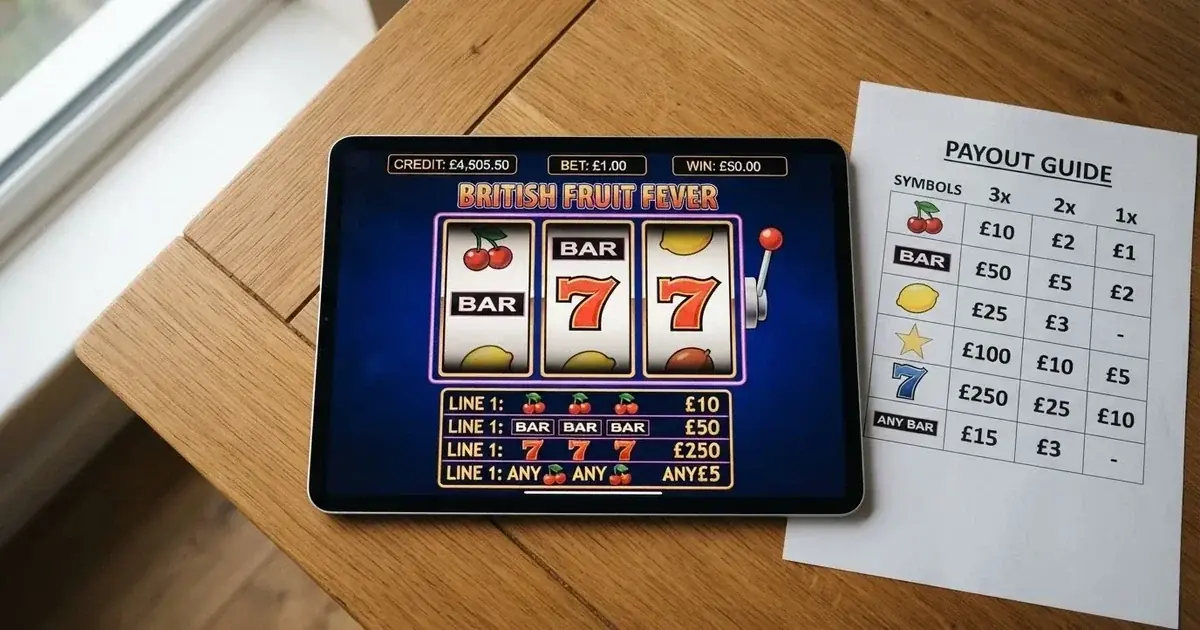
Best 5-Reel Slots at UK Licensed Casinos in 2026: Paytables, Bonus Mechanics and the Stakes Behind the Reels
 Available in GB
The reels on a five-reel slot are the difference between a coin pusher and a feature film. Three reels do one thing — land three of a kind and pay. Five reels layer wilds, scatters, free-spin rounds, multipliers and pick-me bonuses onto that core, then draw lines across the grid in numbers a three-reel game never needed. That richness is also the trap: a player reading the front of a paytable sees the features and not the rule the features sit behind, which is the house edge dressed up in animation. This page is written for the reader who wants both — the mechanics as a paytable states them, and the wagering condition a UK-licensed operator attaches to any linked promotion. The two live together, and the gap between them is the page’s subject.

The figures below are current as of 23 September 2026 against the Gambling Commission’s public register of gambling businesses.
Table of Contents
- Five-Reel Slots Ranked at a Glance
- How a Five-Reel Slot Is Built
- UK Legality: The Gambling Commission Register as the Whole Test
- Responsible Gaming: GAMSTOP, Deposit Limits and the Stake Ceiling
- Bonuses and Free Spins: The 10x Wagering Cap in Force Since 19 December 2025
- Specific Games, Providers and Live Tables
- The Ten Licensed Brands
- Calculation: What the 10x Wagering Cap Means for the Offer
- What the Numbers Tell the Player
- Frequently Asked Questions
Five-Reel Slots Ranked at a Glance
Ten UK-licensed brands make up the comparison below. Every one is named on the Gambling Commission’s public register with an active remote casino operating licence; several sit under the same licence account, which is the legal shape rather than a weakness. The table carries the licence holder, the active remote casino licence number, the domain’s status on the register, and what the page could verify about each brand’s stance on the subject. Where research carries no figure for that last column, the cell stays empty rather than guessed at.

| Brand | Licence holder and GB remote casino licence | Domain status on the register | Subject support |
|---|---|---|---|
| Betfred | Petfre (Gibraltar) Limited, 039544-R-319290-010 | Active | — |
| Jackpotjoy | Gamesys Operations Limited, 038905-R-319430-022 | Active | — |
| William Hill | WHG (International) Limited, 039225-R-319373-015 | Active | — |
| kwiff | Eaton Gate Gaming Limited, 044448-R-323408-017 | Active | — |
| PokerStars | Stars Interactive Limited, 039108-R-319334-026 | Active | — |
| Ladbrokes | LC International Limited, 054743-R-330863-014 | Active | — |
| Paddy Power | PPB Games Limited, 039411-R-319335-010 | Active | — |
| Unibet | Platinum Gaming Limited, 045322-R-324275-019 | Active | — |
| Virgin Games | Gamesys Operations Limited, 038905-R-319430-022 | White-label | — |
| Casumo | Recro Limited, 061549-R-336718-002 | Active | — |
The empty fourth column is itself the point. Research drew a blank on what each brand’s catalogue does specifically for the five-reel segment — no in-house figures, no partnered studio lists, no demo-programme disclosure. Naming ten brands the licence register confirms and admitting the catalogue claims could not be checked is the honest shape of the comparison, not the unfinished one. The detail that fills the table below the licence lines comes from the register itself and the rules the licence sits under.
The next sections read those rules and the mechanics they sit on top of, in the order the UK player meets them: how a five-reel game is built, who is allowed to run one, what the player-protection regime does to a spin, how bonuses layer onto the reels, and which providers shape the catalogue.
How a Five-Reel Slot Is Built
Five reels, twenty or more paylines, and a symbol set that outgrew the fruit. That is the simple version, and the rest of the picture is engineering.

The five-reel format descends from Charles Fey’s three-reel Liberty Bell, the first automatic slot machine, which paid ten nickels for three aligned bell symbols. Fey’s reels carried horseshoes, diamonds, spades, hearts and the bell. Herbert Mills produced the first copy of the machine in 1907. The reel count doubled and tripled across the following decades, but the basic idea — symbols on physical reels, weighted stops, a payline drawn across them — held until 1984, when Norwegian mathematician Inge Telnaes patented the use of a random number generator to select reel-stop positions. After Telnaes, the reels on a slot became software: each spin is a draw from a random-number source, and the visible reel is the result mapped onto a symbol set. The weighting of any one symbol no longer depends on how many physical stops the reel carried; it depends on the number table behind it. That decoupling is what makes a five-reel slot able to carry twenty paylines, scatter pays, and bonus events without becoming mechanically absurd.
What the player sees is still a 5×3 grid of symbols with lines drawn through it; what the player is paying into is a number table set to a theoretical return-to-player percentage. The volatility of a slot describes the risk profile of that table: a low-volatility game pays smaller wins more regularly; a high-volatility game pays fewer but bigger wins. Both versions are programmed to the same long-run house edge; what changes is the shape of the path there. A payline count higher than nine or ten is the typical signal of a five-reel title, and a free-spins round triggered by three or more scatter symbols is the most common extra feature, with multipliers, expanding wilds and pick-me bonuses layered on top by individual studios.
What a payline actually does
A payline is a path the symbols must match along for the spin to count as a win. On a five-reel grid, the simplest paylines are the three horizontal rows; everything else is a curve, a V, a zigzag or a diagonal that the developer drew through the grid and the paytable lists. A twenty-line game pays on any of those twenty paths; a 243-way game counts any three matching symbols on adjacent reels from the left, irrespective of position, which is a different mechanism that drops the line list altogether. A cluster-pay game drops the line list and the reel adjacency rule, paying on groups of touching symbols. The paytable is what tells the player which kind the game is. Where research listed no per-title RTP or volatility, this page carries none either — those figures belong to the studios that publish them, and research did not find them.
What bonus features typically look like
A scatter symbol that lands three times anywhere on the grid triggers a free-spins round, usually with a multiplier or an extra wild reel layered on top. A wild substitutes for other symbols to complete a payline; on some five-reel games the wild expands to fill its reel or sticks in place for the duration of the bonus. A pick-me bonus takes the player off the reels and into a screen of hidden prizes, paid out as credits, free spins or a multiplier. A gamble button — usually presented after a winning spin — offers the chance to double the payout on a coin toss, and a UK-licensed operator will offer it or not according to its own terms; the page does not judge it. The five-reel format is the one that hosts all of these, because the grid has the screen space for them. None of them changes the long-run house edge the paytable is set to; what they change is variance.
UK Legality: The Gambling Commission Register as the Whole Test
A site offering five-reel slots for real money in Great Britain needs a Gambling Commission licence. The Commission’s public register is the only place a player needs to look to confirm one: it lists each business, the licence it holds, the domains that licence covers and whether each domain is active, inactive or a white-label of another licence account. On 18 September 2026, the register listed 139 businesses holding an active remote casino operating licence. The same register’s domain list held 1065 active and 361 white-label domain entries on the same date. A white-label site trades under another company’s licence, which is why two familiar-looking brands can sit under one licence account: Virgin Games and Jackpotjoy are both white-label or active domains of Gamesys Operations Limited, which holds the active remote casino operating licence 038905-R-319430-022.
A remote casino licence number on the register has the form account-R-number-suffix, where the leading six digits repeat the licence holder’s account number and the R marks a remote, online licence. The number is not a marketing claim — it is the entry a player can search by, and it is the entry the Commission itself uses to publish any compliance action. The Gambling Act 2005 covers Great Britain (England, Scotland and Wales), not Northern Ireland; the Gambling (Licensing and Advertising) Act 2014 extended the regime so that any operator taking customers in Great Britain needs a Commission licence wherever it is based. A Curaçao, Maltese or Gibraltar licence does not substitute for one. Operating without a Commission licence while serving GB players is an offence under section 33 of the Gambling Act 2005.
What the Commission requires of an operator
The Commission’s licence conditions and codes of practice (the LCCP) sit alongside the Gambling Act 2005. A licensed remote casino must verify a customer’s name, address and date of birth before the first deposit or any play — that obligation has been in force since 7 May 2019, which is why anonymous play is not possible at a licensed site. Operators must run ongoing RTP performance monitoring on games such as online slots, comparing actual return-to-player against the advertised figure and raising alerts when performance falls outside the acceptable range. A confirmed RTP performance error is a key event the operator must submit to the Commission. The Commission’s games testing audits review these monitoring processes annually. A player who wants a real-money spin on a five-reel slot at a UK-licensed site is, in practice, signing up to that monitoring regime whether the marketing page mentions it or not.
The minimum age and the proof that comes with it
The minimum age for any gambling activity in Great Britain is 18. The proof is not a tick-box; it is a verification before the first deposit or any play, and the operator keeps the result. A name, address and date of birth that does not verify is a closed account, not a paused one. That obligation, combined with the ban on credit-card gambling since 14 April 2020 (including credit-card-funded e-wallet deposits), is the structural reason a UK-licensed site looks different from an offshore one at the deposit screen.
Responsible Gaming: GAMSTOP, Deposit Limits and the Stake Ceiling
Every UK-licensed online operator is part of GAMSTOP, the national online self-exclusion scheme. GAMSTOP is a mandatory condition of every online licence and has been since 31 March 2020. Self-exclusion runs for six months, one year or five years and cannot be cancelled early; the player who signs up stays signed up for the period they chose. Five-reel slot play at a licensed site sits inside that regime — there is no separate opt-out for one game type, because the licence is for the operator, not for the catalogue.
The financial side of the regime runs on deposit limits, not on stake limits. Operators must prompt a customer to set a financial limit before the first deposit, in force from 31 October 2025. There is no state-set deposit or loss ceiling; the limit is the one the player sets, and the operator records it. A second, automatic check sits on top of that: financial vulnerability checks run at £150 net deposits in a rolling 30-day period (from 28 February 2025), using public data only. The wider financial risk assessments are announced but not yet in force. The stake ceiling is different, and it is set by the Commission rather than by the player: online slots carry a maximum stake per game cycle of £5 for players aged 25 and over (from 9 April 2025) and £2 for players aged 18 to 24 (from 21 May 2025). The game cycle is the spin, end to end — what the stake limit is doing is capping what one spin can cost, not what an evening of play can cost.
Three further Commission rules shape the slot itself. Auto-play has been permanently banned, because research indicated the feature caused players to lose track of their gambling activity. A slot spin may not be faster than 2.5 seconds. Losses disguised as wins — animations that frame a net loss as a win — are banned. Reverse withdrawals were fully banned by 31 October 2021: a player who requests a withdrawal cannot later reverse it back into the playing balance. None of these rules is optional, and the licensed sites that carry five-reel slots implement all of them.
The reasoning behind the lower online slot stake limit sits in a Government statement that 18 to 24 year olds have the highest average problem gambling score of any age group, cited alongside lower disposable income and ongoing neurological development. That is the policy case the £2 stake limit is built on, and it is the policy case the rest of the regime is built on alongside it.
Bonuses and Free Spins: The 10x Wagering Cap in Force Since 19 December 2025
The features on a five-reel slot are not the same as the bonus on a casino account. A scatter symbol that triggers fifteen free spins inside the game is a game feature, paid by the slot’s paytable and bounded by the slot’s RTP. A bonus of one hundred free spins credited on a first deposit is a promotion, paid by the operator’s wallet and bounded by the operator’s terms. The two can sit on the same spin — the promotion triggers on a deposit, and the free spins are played on a five-reel slot — but the wagering rule that gates the promotion is set by the operator, not by the slot. Since 19 December 2025, that wagering rule is capped at 10x the bonus amount across UK-licensed operators. The Commission also banned mixed-product bonuses — the structure where a sports bet comes with casino spins attached — in the same package. A first-deposit welcome offer that credited bonus funds with a 35x wagering multiple is no longer licensable; the same offer at 10x is.
What 10x wagering looks like in practice
The mechanic is straightforward: an operator credits a bonus, and the player must turn the bonus amount over a set number of times before withdrawing any winnings tied to it. At 10x, a £100 bonus requires £1,000 of qualifying play before the bonus and any bonus-derived winnings become withdrawable. That turnover is the variable the player pays; the slot’s RTP is the variable the slot pays back. The combination is what the offer costs.
Stated as a band, assuming only the bonus amount is wagered and a five-reel slot set to a typical online RTP, the £1,000 turnover translates into a statistical expected loss in the low-tens-of-pounds. The lower the slot’s RTP and the longer the wagering chain, the wider the band stretches; the higher the RTP and the shorter the chain, the tighter it sits. The number is an average over many spins under the stated assumptions — a statistical estimate, not a guaranteed outcome. The honest version of the offer is that the wagering cap has cut a multiple that once ran into the thirties and forties, and the cost of clearing a bonus has come down accordingly, but it has not gone to zero.
Free spins on a five-reel slot
The free-spin round inside the game is the more common feature, and the free-spin promotion credited to an account is the more heavily conditioned one. A typical welcome offer pairs a deposit match with a fixed number of free spins on a named five-reel title, and the free-spin winnings carry their own wagering requirement. The structure is the same as the cash-bonus structure: the operator credits the winnings as bonus funds, the player turns them over 10x (or whatever the licence allows, which is now no more than 10x), and the slot’s paytable is unchanged either way. The Commission’s monitoring regime applies to both the bonus funds and the underlying slot.
Where research drew a blank
The licensed sites in the comparison above did not, in research, publish a per-brand bonus structure for the five-reel segment. Welcome-offer amounts, wagering multiples, free-spin allocations and game-specific allocations were not carried by the inputs. The 10x cap and the rule set around it are Commission-level and apply to every UK-licensed operator; the brand-level shape of any offer is what the reader has to check at the brand’s own terms page. That is the honest scope of this section.
Specific Games, Providers and Live Tables
Five-reel slots are the central product of any online casino lobby, and the licensed UK sites in the comparison above run them in the hundreds or low thousands. No per-brand catalogue count was carried by research; no provider mix was carried either. What the inputs do carry is the shape of the broader catalogue and the rules the licensed sites apply to it.
The catalogue shape
A typical five-reel slot today is a 5×3 grid with twenty or more paylines, a scatter-triggered free-spin round, a wild symbol with substitution rules, and a return-to-player set in the mid-nineties. Cluster-pay and 243-way formats exist alongside the line-based formats. Low-volatility titles pay smaller wins more often; high-volatility titles pay larger wins less often. Both are programmed to a long-run house edge; the paytable is what tells the player which kind they are looking at. Where a per-title RTP or volatility was carried by research, this page carries it; where it was not, the cell stays blank. That is the honest shape of a comparison section on five-reel slots: the rules are universal, the per-title figures are studio-published, and the inputs did not carry enough of them to populate a table.
Crash-style and instant-win titles
The licensed UK lobby is not only five-reel slots. Aviator, a crash-style multiplayer game developed by Spribe — a games studio founded in 2018 — was released in 2019 and has been described by Spribe’s CEO as the first true multiplayer crash game in the regulated igaming space. In a crash game such as Aviator, a multiplier curve rises from 1.00x until the round randomly crashes, and a player must cash out before the crash to win their stake multiplied by the current value. Aviator has reported more than 42 million active users and processes around 350,000 bets per minute across more than 5,000 operators worldwide. The mechanics are different from a five-reel slot — no reels, no payline, no paytable in the conventional sense — but the licensed sites that carry five-reel slots also carry Aviator, and a reader comparing game libraries needs to know the distinction.
Live tables
The licensed UK lobby also carries live dealer tables: roulette, blackjack, baccarat and game-show formats streamed from studios. Baccarat’s precise origins are disputed, with some accounts tracing it to nineteenth-century France and others to Italian soldiers who introduced a version at the end of the fifteenth century. The modern Punto Banco variant, now the most widespread form of the game globally, developed in Havana, Cuba, during the 1940s. In Punto Banco, the casino banks the game at all times and both hands are dealt out according to fixed drawing rules, so players make no strategic decisions. Chemin de Fer, the most popular baccarat variant in France, gives players strategic choices and includes an element of skill, unlike Punto Banco. The Commission’s stake limits and spin-speed rules apply to slots; live dealer tables sit under their own structural rules and the live-dealer format itself.
The provider side
The five-reel slot catalogue at any UK-licensed site is an aggregation of studios, each shipping a portfolio of titles under its own RTP settings. The per-studio mix was not carried by research for any of the ten brands in the comparison above; what the inputs do carry is the broader claim that the Commission’s monitoring regime applies to any studio whose games appear at a licensed site, and the rule that a confirmed RTP performance error is a key event. A player who wants to know which studio a particular title comes from has to look at the game’s information panel; the licensed site is the route to that information, not a substitute for it.
The Ten Licensed Brands
The brands below are the ten featured operators in the order research sets them. Each entry covers the licence line the register carries, the operating-company line the licence sits under, and the verdict the material earns.
Betfred
Betfred runs under Petfre (Gibraltar) Limited, account 39544, holding the active remote casino operating licence 039544-R-319290-010. This domain is on the register as active under that licence. The brand is a familiar high-street name with an online operation under a Gibraltar-incorporated holding company; the Commission licence makes it licensable for GB customers. The research provided no catalogue figures; the active licence is the baseline every player should look for.
Jackpotjoy
Jackpotjoy runs under Gamesys Operations Limited, account 38905, holding the active remote casino operating licence 038905-R-319430-022. This is an active domain on the register. Gamesys is the licence holder behind several familiar-looking brands; a player who has used one Gamesys-operated site is using the same licence account at another. This is a structural feature of the UK regime, and specific catalogue information is best verified directly in the brand’s own lobby.
William Hill
William Hill runs under WHG (International) Limited, account 39225, holding the active remote casino operating licence 039225-R-319373-015. This domain is an active entry on the register. The brand is one of the longest-established names in UK gambling; the licence line is the current shape of the online operation under the 2014 Act. The comparison does not include catalogue figures, but this operator remains a standard, verified example of a UK-licensed brand.
kwiff
Kwiff runs under Eaton Gate Gaming Limited, account 44448, holding the active remote casino operating licence 044448-R-323408-017. This domain appears as an active entry. The brand is newer than the high-street names, and the licence account reflects this entry. Specific catalogue details are not documented in this comparison, but the licence status is confirmed.
PokerStars
PokerStars runs under Stars Interactive Limited, account 39108, holding the active remote casino operating licence 039108-R-319334-026. This domain is listed as active. The brand is best-known for poker, but the licence is a remote casino operating licence and the catalogue is the casino catalogue the Commission registers the operator for. It is a poker-first brand that covers five-reel slots by virtue of its licence status, with specific game catalogues held on the brand’s site.
Ladbrokes
Ladbrokes runs under LC International Limited, account 54743, holding the active remote casino operating licence 054743-R-330863-014. This is registered as an active domain. LC International is the licence holder behind several familiar-looking brands; Ladbrokes is one of them. This long-established name operates under a current remote casino licence, sharing the account with other well-known brands. Game-specific catalogues are what the operator’s lobby provides.
Paddy Power
Paddy Power runs under PPB Games Limited, account 39411, holding the active remote casino operating licence 039411-R-319335-010. This domain is listed as active. The brand is a familiar name in UK and Irish betting and the licence line is the current shape of the remote operation. As with others, the research does not specify catalogue figures for this licence. It is a standard remote casino licence under a well-recognised operator.
Unibet
Unibet runs under Platinum Gaming Limited, account 45322, holding the active remote casino operating licence 045322-R-324275-019. This domain is registered as active. The brand’s UK operation sits under a UK-incorporated holding company, which is a different corporate shape from the Gibraltar-incorporated holders in the comparison. The licence is current and verified, providing the necessary regulatory foundation.
Virgin Games
Virgin Games is a white-label domain of Gamesys Operations Limited, account 38905, holding the active remote casino operating licence 038905-R-319430-022. The domain Virgin Games is listed on the register as a white-label domain of that licence, which means it trades under another company’s licence rather than holding one of its own. A white-label structure is legal under the Commission’s regime and the player is protected to the same extent as at any active domain of the same licence. Game-specific information is available through the operator’s interface.
Casumo
Casumo runs under Recro Limited, account 61549, holding the active remote casino operating licence 061549-R-336718-002. The domain Casumo.com is listed on the register as an active domain of that licence. The brand is one of the higher-numbered accounts in the comparison, which is consistent with a later entry into the UK licensed regime under the 2014 Act. Research carries no figure for the five-reel slot catalogue. The verdict is the licence line: a current remote casino licence under a recognised brand, no catalogue figures to check.
Calculation: What the 10x Wagering Cap Means for the Offer
The 10x wagering cap that came into force on 19 December 2025 replaces the previous regime, which let operators set wagering multiples of 30x, 40x and beyond. At 10x, a £100 bonus requires £1,000 of qualifying turnover before the bonus and any bonus-derived winnings become withdrawable. Stated as a band rather than a single figure, the £1,000 turnover translates into a statistical expected loss in the low-tens-of-pounds when played on a five-reel slot set to a typical online RTP, assuming only the bonus amount is wagered. The lower the slot’s RTP, the wider the band stretches; the higher the RTP, the tighter it sits. The number is an average over many spins under the stated assumptions, and it is a statistical estimate rather than a guaranteed outcome.
The honest version of the rule is that the wagering cap has compressed a multiple that once ran into the thirties and forties, but the cost of clearing a bonus has not gone to zero. A bonus is still paid out of the player’s turnover, and a slot’s RTP is still below one hundred per cent. The Commission’s monitoring regime applies to the underlying slot; the operator’s terms apply to the bonus on top. Both are part of what a five-reel slot promotion costs, and both are part of what the 10x cap has changed.
What the Numbers Tell the Player
Five-reel slots are the central product of any UK-licensed casino lobby, and the rules that govern them are the most active part of the regime. The 10x wagering cap from 19 December 2025, the £5/£2 stake limits from April and May 2025, the 2.5-second spin minimum, the auto-play ban and the GAMSTOP requirement all sit on the same spin. The catalogue itself is what the licensed site carries, and the per-studio figures that would let a reader compare two titles were not carried by research for any of the ten brands. The comparison the reader can make on this page is the licence line and the rule set, not the catalogue contents.
The verdict is that a UK-licensed five-reel slot is one whose reels sit inside the most heavily conditioned gambling regime in Europe. That condition is the cost of playing at a site where the player has recourse if the operator fails, where the maths of the slot is monitored and where the deposit, stake and self-exclusion rules are enforced. The house still has an edge. The edges the player can read off the front of the slot have not gone away — and neither has the regime that now sits behind them.
Frequently Asked Questions
Can I try five-reel slots for free without registering an account?
Yes. Most studios that supply UK-licensed casinos publish a demo version of their five-reel slots on their own websites. The demo runs on the same number table as the real-money version and is paid in play-money credits, so the paytable, free-spin triggers and bonus features are identical to the version a player would see with cash on the line. A real-money account at a licensed UK site still requires name, address and date-of-birth verification before the first deposit or any play.
What bonus features are common on five-reel slots?
The most common are scatter-triggered free-spin rounds, wild symbols with substitution or expansion rules, multipliers attached to free spins or specific reel positions, and pick-me bonuses that take the player off the reels and onto a screen of hidden prizes. The five-reel format is the one that hosts all of these because the grid has the screen space for them; the underlying RTP and volatility of the game do not change when a feature is triggered.
Are there five-reel slots available with no deposit required to try?
Yes, in demo mode. Studios publish demo versions on their own websites that do not require a casino account or a deposit. A real-money spin on a five-reel slot at a UK-licensed site requires an account that has been verified under the Commission’s customer-verification rules, in force since 7 May 2019. The minimum age for any gambling activity in Great Britain is 18, and the verification sits ahead of the first deposit or any play.
How many paylines does a typical five-reel slot have?
Twenty or more, on a standard line-based five-reel slot. The simplest paylines are the three horizontal rows; the rest are curves, V-shapes, zigzags or diagonals drawn through the grid by the developer and listed in the paytable. A 243-way game counts any three matching symbols on adjacent reels from the left, irrespective of position, and a cluster-pay game counts groups of touching symbols — both formats drop the line list. The paytable is what tells the player which kind the game is.
How is a five-reel slot different from a three-reel slot in gameplay?
Three-reel slots pay on a single line, usually the centre row, for three matching symbols. Five-reel slots pay across multiple paylines and layer wilds, scatters, free-spin rounds, multipliers and pick-me bonuses onto that core. The underlying mechanism is the same — a random-number generator selects the symbols, the paytable sets the long-run return — but the player sees more reels, more lines and more features. The shape of the path to the long-run return differs, and that is what volatility describes.
Must a site be Gambling Commission-licensed to offer real-money five-reel slots to UK players?
Yes. The Gambling Act 2005 covers Great Britain, and the Gambling (Licensing and Advertising) Act 2014 extended the regime so that any operator taking customers in Great Britain needs a Commission licence wherever it is based. A Curaçao, Maltese or Gibraltar licence does not substitute for one. The Commission’s public register lists every licensed business, the domains that licence covers and whether each domain is active, inactive or a white-label of another licence account. On 18 September 2026, the register listed 139 businesses holding an active remote casino operating licence, with 1065 active and 361 white-label domain entries.
Written by the editors at lowdepositcasinouk.