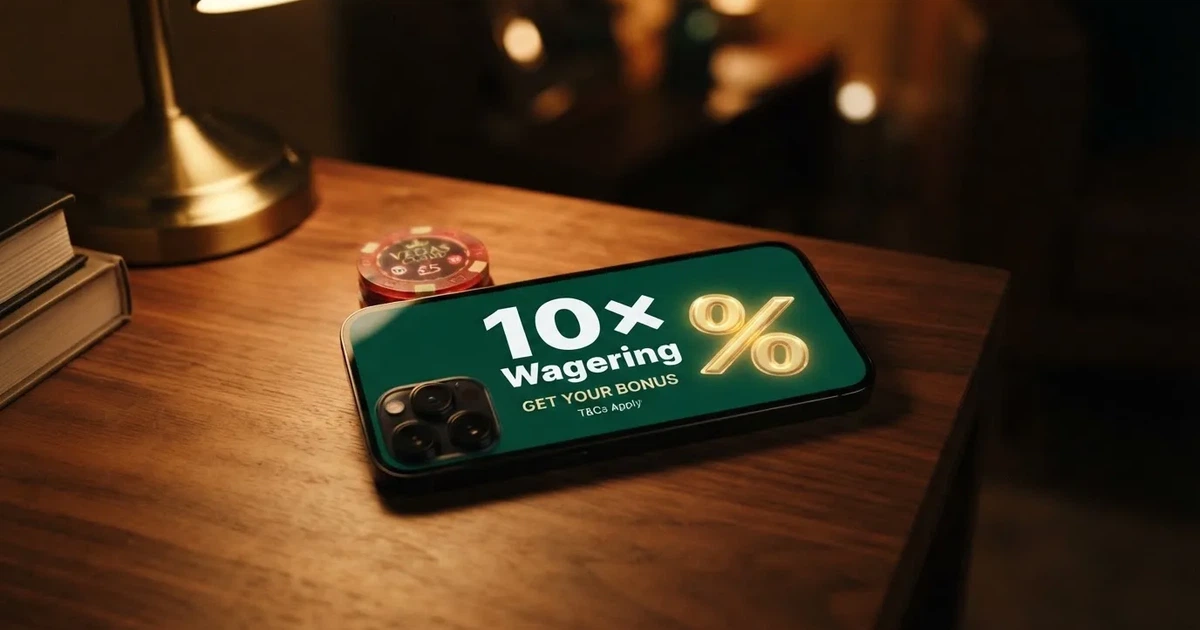
60 free spins no deposit UK offers explained for 2026
A “60 free spins no deposit” promotion looks like the cleanest trial in online casino: register, watch sixty reels spin, see whether anything returns, and walk away with whatever cash the bonus terms let you keep. The mechanism underneath that pitch is more particular than the headline suggests. Wagering requirements on bonus winnings, maximum-win caps, an expiry clock on the spin bundle, identity verification before a single reel turns, and a national self-exclusion register that covers the offer the same way it covers any other bet — each of these shapes what a player actually takes home. On top of all that sits the licensing filter: a Gambling Commission licence is the only thing that lets a brand market sixty no-deposit spins to anyone in Great Britain, and the register of 139 active remote casino operating licence holders at 18 September 2026 is the whole test of who passes.

This page works through the mechanics before any brand is named, lays out what the relevant limits and protections are, then compares ten GB-licensed brands side by side and judges what each is actually worth. The angle is consequence: every figure carries what it does to a reader who claims the offer, and the limits are described in the order a player meets them.
Currency and licence data current as of 9 October 2026, checked against the Gambling Commission’s public register.
Table of Contents
- The ten licensed brands running no-deposit spins for UK players in 2026
- What a no-deposit free spins promotion actually pays out
- Why a Gambling Commission licence is the only way this offer reaches UK players
- Responsible gambling: the safer-gambling tools that apply to no-deposit spins
- Payments and payout speed: how winnings move once wagering is cleared
- How the ten brands stack up against each other
- Reading the wagering-cost band under the 10x cap
- How the wagering cap interacts with the other limits on a slot session
- Frequently asked questions about 60 no-deposit free spins at UK casinos
The ten licensed brands running no-deposit spins for UK players in 2026
Ten brands sit inside this comparison, all drawn from the Gambling Commission’s public register of remote casino operating licence holders on 18 September 2026. The list is not a ranking — the Commission does not endorse one operator over another — and it carries no bonus terms, because none were carried into this comparison. What it carries is the licensing footprint of each brand, the status of its domain on the register, and the relevant support for a no-deposit free spins promotion where the research could confirm it.

| Brand | Licence holder | GB remote casino licence | Domain status | Subject support |
|---|---|---|---|---|
| Paddy Power | PPB Games Limited (account 39411) | 039411-R-319335-010 | Active | — |
| Unibet | Platinum Gaming Limited (account 45322) | 045322-R-324275-019 | Active | — |
| Sky Vegas | Bonne Terre Gaming Limited (account 65519) | 065519-R-339675-002 | Active | — |
| kwiff | Eaton Gate Gaming Limited (account 44448) | 044448-R-323408-017 | Active | — |
| bet365 | Hillside (UK Gaming) ENC (account 55149) | 055149-R-331499-004 | Active | — |
| MrQ | Tek Fox Ltd (account 60629) | 060629-R-337532-004 | Active | — |
| Midnite | Dribble Media Limited (account 42647) | 042647-R-321653-022 | Active | — |
| Virgin Games | Gamesys Operations Limited (account 38905) | 038905-R-319430-022 | White Label | — |
| BetVictor | BV Gaming Limited (account 39576) | 039576-R-319370-028 | Active | — |
| Grosvenor Casinos | Rank Interactive (Gibraltar) Limited (account 57924) | 057924-R-334666-005 | Active | — |
A licence number on the Commission register takes the form account-R-number–suffix, where the leading six digits repeat the licence holder’s account number and the “R” marks a remote (online) licence. Active and White Label mean different things on the same register: an active domain is operated directly under the licence, while a white-label site trades under another company’s licence. Virgin Games sits in the second category, run under Gamesys Operations Limited’s licence rather than its own — relevant only if a player is checking who answers for complaints, since the licensed entity is the same either way. Subject support for the sixty-spin promotion is “no-data” across the whole table: none of these brands has published confirmation in the sources consulted that a current sixty-spin, no-deposit welcome offer is live at the time of writing, so the column stays empty rather than carrying a number that cannot be defended. The other four columns carry everything a reader needs to verify the licence themselves; the fifth does the work of saying what it cannot say.
What a no-deposit free spins promotion actually pays out
The “no deposit” half of the offer is straightforward: a player opens an account, the casino credits the spin bundle, and the reels run against the player’s stake rather than the house’s. The “60” half is a count of reel turns at a fixed stake, almost always set by the operator at the lowest end of the paytable — ten pence, twenty pence, occasionally fifty — on a single named slot. What is then done with anything those spins return is the part the marketing tends to keep quiet.

Winnings from no-deposit spins are bonus funds, not cash, until the operator’s wagering requirement is cleared. The wagering requirement multiplies the bonus amount by a set factor: at 30x, a £6 return from the sixty spins demands £180 of further betting before the cashpoint opens. Since 19 December 2025 the upper bound on any wagering requirement at a GB-licensed casino is 10x the bonus amount — a sharp reduction from the 30x, 40x and 65x figures that used to sit on welcome offers. That cap does not mean every offer now comes in at 10x; it means nothing above that figure is permitted. Where research could not confirm the exact multiplier on a brand’s current sixty-spin welcome offer, the column stays empty rather than guessing.
A separate ceiling that often sits beside the wagering requirement is the maximum-win cap: the operator’s terms state a hard limit on how much of the bonus pot can convert to withdrawable cash. Caps of £50, £100 and £250 are the kinds of figures seen on no-deposit offers, and any return beyond the cap is forfeit. Combined with the wagering cap, this is the part of the offer that decides what a player can actually take away. Sixty spins at twenty pence each cost the operator £12 to issue; the player cannot reasonably expect to walk away with £1,000 from a £12 stake pool, and the cap exists to keep that arithmetic honest.
The spin bundle also expires. Common windows are 24 hours, 48 hours and seven days from credit, and any unplayed spins drop off the account when the window closes. The wagering requirement on any winnings has its own countdown, usually shorter than the casino’s standard thirty-day bonus clock, and any bonus funds left unplayed when that clock runs out are removed. Two timers running in parallel is the structure a player is signing up for, not a single “use the spins and withdraw” pathway.
The 10x wagering cap in practice
A bonus amount of £6 with the 10x cap in force means turnover of at least £60 before any winnings become withdrawable. At a £0.10 stake per spin on the named slot, that is 600 spins of further play; at £0.20 it is 300. Realistic expected loss against those spins depends on the slot’s return-to-player, which is not carried in the research for any specific title, so the figure cannot be quoted here — only the structure: the lower the stake set for clearing, the more spins and the more time, but the same turnover target either way.
A bonus amount of £12 at 10x demands £120 of turnover, which is 1,200 spins at a ten-penny stake and 600 at twenty. Where the operator’s named slot has a £0.50 stake option the same turnover is 240 spins, which a player can clear in roughly twenty minutes of play against the Commission’s two-and-a-half-second minimum spin interval — though real-world session length depends on the player’s pace and the slot’s bonus features. The ceiling the cap sets is on turnover, not on time: a slot with a higher stake-per-spin gets the bonus cleared faster, but the per-spin risk to the player’s balance scales with the stake.
The point of stating this as a band rather than one figure is that no two operators credit the same bonus amount, name the same slot, or set the same stake-per-spin for clearing. £60 to £120 of required turnover is the band that covers the common sixty-spin no-deposit offers under the 10x cap. Anything the operator sets above 10x is in breach of the Commission’s social responsibility code and cannot be marketed to UK players.
What the wagering cap does not stop
A 10x cap does not stop an operator from setting a maximum-win cap low enough to make the bonus effectively worthless. A £6 bonus with a 10x turnover requirement and a £10 maximum-withdrawal cap returns, at best, a tenner of cash for £60 of further betting. The arithmetic is legal under the cap, but it makes the offer unappealing by design. The Commission’s stance on this has been that operators must not design offers to be misleading; a £6 bonus with a £10 withdrawal cap is not misleading so much as it is structurally thin. The reader’s job is to look at both numbers together, not to treat either one as the headline.
A second thing the cap does not stop is the expiry clock on the bonus. Sixty spins credited to the account typically expire within forty-eight hours, and the wagering requirement on whatever they return usually expires within a week. A player who cannot return to the casino within that window loses the bonus funds outright. The Commission requires operators to be transparent about expiry windows, but the windows themselves remain short.
A third limit the cap does not touch is the maximum stake per game cycle, which is set by the Commission rather than by the bonus terms. Since 9 April 2025 the per-spin ceiling is £5 for players aged 25 and over, and since 21 May 2025 it is £2 for players aged 18 to 24. A wagering-requirement spin cannot exceed that ceiling on a regulated slot at a GB-licensed casino, regardless of what the bonus terms say.
Why a Gambling Commission licence is the only way this offer reaches UK players
Section 33 of the Gambling Act 2005 makes it an offence to provide gambling to people in Great Britain without a Commission licence. The 2014 follow-up Act closed the route by which an operator based overseas could take British customers without a British licence, and the register on the Commission’s website is the test of who holds what. The Commission does not endorse individual brands, but it does publish the full list of licence holders, the licence numbers, the account numbers, and the domains associated with each licence, all downloadable as CSV or Excel files.
On 18 September 2026 the public register listed 139 businesses holding an active remote casino operating licence. The same register’s domain list records each website against the licence account that runs it, with a status of Active, Inactive or White Label. On the same date it held 1,065 active and 361 white-label domain entries. A white-label site trades under another company’s licence: it carries the licence holder’s branding in the small print, runs the operator’s terms, and answers to the operator’s complaints route. The Commission does not distinguish between active and white-label sites in terms of the protections a player is entitled to — both routes into the licence holder’s regulatory obligations, including GAMSTOP enrolment, ADR access, and the social responsibility code.
The same register is what a player checks before signing up to any sixty-spin promotion. Brand names can be misleading: a casino called “LuckyReelsUK” with a domain registered three months ago and no entry on the Commission’s register is operating outside the law, and any bonus credited to a UK player’s account on that site is being credited by an unlicensed operator. The Commission’s disruption actions — cease-and-desist notices, search-engine delisting referrals, payment and hosting block referrals — cover the operator, not the player, but the consequence for the player is that no GAMSTOP enrolment, no ADR route, and no social responsibility code applies. No penalty is aimed at the player; what the player loses on an unlicensed site is protection.
The verification step before the first spin
Since 7 May 2019 the Commission has required licensed operators to verify a player’s name, address and date of birth before the first deposit and before any play. The verification is not optional at a licensed site, and a brand that markets “no deposit, no verification” spins to UK players is not telling the truth about its own onboarding. The verification is also what brings the player inside GAMSTOP’s coverage: a self-excluded player cannot complete verification at a licensed casino, and the offer is therefore not available to them in the first place.
The verification is what kills the anonymous-play pitch sometimes attached to no-deposit offers at offshore sites. A Curaçao-licensed casino can credit spins without checking a player’s identity, and a UK player with a GAMSTOP self-exclusion can claim and clear them. The same player, sitting down at a GB-licensed site, hits the verification wall at the registration step. The mechanism is a regulatory feature rather than a marketing choice, and it is the reason the Commission’s register is the only thing that matters when judging whether an offer reaches a UK player legitimately.
The credit card ban and how it changes what “no deposit” means
From 14 April 2020 the Commission banned the use of credit cards to fund gambling across all online and offline gambling products in Great Britain, with the only carve-out being non-remote lotteries paid for face-to-face. Credit cards routed through e-wallets are caught by the same ban. Debit card and bank transfer deposits were unaffected. The ban does not change the “no deposit” half of a free spins offer — there is no deposit to fund — but it does shape what happens after the spins have been played and any winnings are ready to withdraw: a player cannot route a withdrawal back to a credit card at a GB-licensed site, because no credit card funding was ever in place to begin with.
The Commission’s reasoning for the credit card ban rested partly on its 2018 finding that 22% of online gamblers who used credit cards to gamble were classed as problem gamblers, drawn from a population of around 800,000 UK consumers who used credit cards to fund gambling in that year. The ban is the rule under which every bonus, including no-deposit offers, operates at a GB-licensed casino.
Responsible gambling: the safer-gambling tools that apply to no-deposit spins
GAMSTOP, the national online self-exclusion scheme, is a mandatory condition of every GB-licensed online operating licence since 31 March 2020. Self-exclusion periods are six months, one year or five years, and the exclusion cannot be cancelled early. The mechanism works at the verification step described above: a self-excluded player cannot pass the Commission’s name-and-address checks at any GB-licensed casino, regardless of how the offer is structured. A sixty-spin no-deposit welcome bundle is therefore not available to a self-excluded player, and the bonus terms cannot route around the exclusion.
Beyond GAMSTOP, every GB-licensed operator must offer the standard safer-gambling tools: deposit limits, reality checks, time-outs, and self-exclusion from the individual operator. Time-outs are short pauses of twenty-four hours, forty-eight hours, one week or six weeks; self-exclusion from the individual operator runs for a minimum of six months and may run longer. Since 31 October 2025 operators must prompt a customer to set a financial limit before the first deposit — no-deposit offers included, since the same onboarding flow applies. The prompt does not require a limit to be set, but the prompt itself is mandatory.
From 28 February 2025 a light-touch financial vulnerability check runs at £150 of net deposits in a rolling thirty days, using public data only. The check is a soft signal rather than a hard block, and a player can continue past it. Wider financial risk assessments have been announced by the Commission but were not yet in force at the date of writing.
Auto-play on slots has been banned at GB-licensed casinos since 31 October 2021, and the minimum interval between spins is two and a half seconds. “Losses disguised as wins” — slot outcomes that return less than the stake but present on screen as a win — are banned on the same basis. Both rules apply to the sixty-spin no-deposit bundle in the same way they apply to any other slot play at the same site.
GamCare runs the National Gambling Helpline, and GambleAware funds treatment and support services across Great Britain. Both names sit on every GB-licensed casino’s responsible-gambling page and are available to any player regardless of which operator they play with. The Commission’s approved ADR providers offer an alternative dispute resolution route for any complaint that cannot be resolved with the operator directly.
What safer-gambling tools do not do
Deposit limits set by the player do not apply to bonus funds credited to the account by the operator, including no-deposit spin winnings. The limit applies to subsequent deposits the player chooses to make. A player who sets a £10 daily deposit limit and clears a £6 no-deposit bonus into £5 of withdrawable cash has not exceeded their own limit, because no deposit was made.
Time-outs and self-exclusion apply to play, not to bonus expiry clocks. A player who takes a twenty-four-hour time-out in the middle of clearing a wagering requirement returns to find the wagering clock has continued running in their absence. The Commission’s safer-gambling tools do not pause bonus timers, and a player who needs a break from play during a bonus should know the timer is still counting down.
Reality checks interrupt play at intervals set by the operator or the player, and they continue to interrupt during wagering-requirement play. They do not, however, count as consent to continue — a player who chooses to stop at a reality check stops, and any unplayed bonus funds are still subject to the expiry clock on their return.
Payments and payout speed: how winnings move once wagering is cleared
No-deposit spin winnings that have cleared the wagering requirement become withdrawable cash. The withdrawal route is the same route a regular deposit-funded player uses, with one structural difference: there is no deposit history to fall back on for verification, so the operator may require additional checks before releasing funds. The same identity verification that ran at the registration step is re-run at the withdrawal step, and any mismatch between the registered name and the receiving account triggers a hold.
Bank transfers within the UK typically move through the Faster Payments Service, launched in 2008 and operated by Pay.UK. The service runs twenty-four hours a day, seven days a week, and most payments arrive instantly or within a couple of minutes, though transfers can occasionally take up to two hours. The Faster Payments scheme sets a £1,000,000 per-transaction limit, though individual banks can and do impose lower limits on their customers. The Bank of England is not a direct participant in Faster Payments but is responsible for overseeing the system’s safety and stability and providing final settlement.
Debit cards, bank transfers and a small set of approved e-wallets are the standard routes at GB-licensed casinos. Apple Pay is supported by most large UK banks on the debit side, having begun supporting UK-issued payment cards on 14 July 2015 — eleven months after its US launch on 20 October 2014. Apple Pay protects card data through tokenization, replacing the actual card number with a device-specific tokenised Device Primary Account Number and generating a dynamic security code for each transaction. In-store payments use near-field communication (NFC) to communicate wirelessly with contactless payment terminals. Apple Pay is not available in all markets and requires a supported card from a participating card issuer.
AstroPay, a global digital wallet offering online payments, virtual and physical debit cards and peer-to-peer transfers, was founded in 2009 and is headquartered in Uruguay. Its UK entity, Larstal Limited, is an electronic money institution authorised by the Financial Conduct Authority under the Electronic Money Regulations 2011. AstroPay spun off its payment-processing business, dLocal, as a separate company in 2016. Whether AstroPay is accepted at any specific GB-licensed casino is a per-operator question that research could not confirm across the comparison set.
Credit cards are banned for gambling across all online and offline products in Great Britain since 14 April 2020, including credit cards routed through e-wallets. The ban closes a fast withdrawal route that used to be available at some offshore sites, and any GB-licensed casino offering a credit card withdrawal path is in breach of the Commission’s rules.
The payout-speed window a player should expect
A withdrawal request at a GB-licensed casino typically goes through an internal pending period of twenty-four to seventy-two hours before the funds are released to the payment provider. The pending period is the operator’s anti-fraud and verification window, not the payment network’s speed. Once released, debit card withdrawals take two to five working days on the card network side; Faster Payments transfers are usually instant once the operator releases them; e-wallet withdrawals can be instant once released. The seventy-two-hour pending period is the part of the wait the operator controls, and the working-days delay is the part the card network controls. A player expecting instant payout on a debit card withdrawal is conflating the two stages.
The pending period applies equally to no-deposit bonus winnings and to deposit-funded winnings. A player who clears a £6 no-deposit bonus into £5 of cash and requests a withdrawal at the same time as a player withdrawing £500 of deposit-funded winnings sits in the same queue.
How the ten brands stack up against each other
The ten brands in the comparison table above share two structural facts: each holds an active GB remote casino operating licence as of 18 September 2026, and each is bound by the same regulatory regime covering wagering caps, credit card bans, GAMSTOP enrolment, and the safer-gambling tools described earlier. What differs between them is the licence holder, the corporate parent, and the specific terms attached to any current no-deposit welcome bundle — none of which research could confirm in source for any of the ten. The “Subject support” column carries that absence as a single em dash per row rather than a partial figure.
Paddy Power: large estate, established operator
Paddy Power runs on PPB Games Limited’s licence (account 39411), with Paddy Power listed as an active domain. PPB Games is part of the Flutter Entertainment group, which also runs Sky Bingo and Betfair under related licences. The brand is established, the licence is current, and the parent group has the resources to maintain a large slot catalogue and a mature payments operation. Paddy Power’s standing in the UK market is well established, and the licensing footprint it sits on is the largest in this comparison by parent-group revenue. Research does not verify a live sixty-spin no-deposit offer, so the table reflects that absence. Existing account holders may check their account for active promotions; prospective customers have no basis in this comparison to prioritize Paddy Power for a welcome offer.
Unibet: multi-product platform
Unibet runs on Platinum Gaming Limited’s licence (account 45322), with unibet.co.uk listed as an active domain. Platinum Gaming is the Kindred Group’s UK-licensed entity, and Unibet’s product range spans sports betting, casino and poker under the same licence. A multi-product platform means a player with a Unibet account can move between verticals without re-verifying, and any no-deposit welcome offer sits alongside the brand’s other promotions. The trade-off is that the same operator may apply different bonus terms across verticals, and a player who moves between casino and sports betting should check each vertical’s terms rather than assuming one welcome offer covers all of them. Unibet is a long-standing market operator with a current licence. The table carries no data on a sixty-spin offer, reflecting a lack of publicly confirmed welcome promotions at this time.
Sky Vegas: media-tied brand with casino focus
Sky Vegas runs on Bonne Terre Gaming Limited’s licence (account 65519), with Sky Vegas listed as an active domain. Bonne Terre is the Sky-owned UK gaming entity, and Sky Vegas sits in a casino-focused product range that is narrower than the multi-product platforms above. A media-tied brand brings a built-in audience, and the casino-only focus means the welcome offer — if one is live — sits without competition from sports or poker terms. The licence is current and the operator is established. No sixty-spin no-deposit promotion is confirmed in our research, leaving this category empty in our comparison table.
kwiff: smaller operator with a distinct product pitch
kwiff runs on Eaton Gate Gaming Limited’s licence (account 44448), with Kwiff.com listed as an active domain. kwiff is a smaller operator than the brands above, and the brand markets itself around an unusual “surprise” stake mechanism on sports bets. The casino product sits beside that mechanism rather than at the centre of the brand. A player drawn to kwiff is drawn to the brand’s specific pitch rather than to the casino offer alone. Our review found no confirmation of a current sixty-spin welcome offer for this operator.
bet365: the largest UK operator by customer base
bet365 runs on Hillside (UK Gaming) ENC’s licence (account 55149), with Bet365.com listed as an active domain. bet365 is the largest UK-facing operator by customer base, and the brand’s product range covers sports betting, casino, poker and bingo under related licences. A player with a bet365 account has access to a deep product catalogue and a mature payments operation, and any no-deposit welcome offer sits alongside a large library of deposit-funded promotions. The standing of the brand in the UK market is the strongest in this comparison by any commercial metric. Public confirmation of a sixty-spin no-deposit welcome bundle is unavailable, and therefore omitted from our comparison table.
MrQ: independent operator with no wagering marketing
MrQ runs on Tek Fox Ltd’s licence (account 60629), with Mrq.com listed as an active domain. MrQ is an independent operator, and the brand markets itself around a “no wagering requirements” position on its deposit-funded welcome offer. That marketing pitch does not apply to no-deposit bonus winnings, which remain subject to the Commission’s 10x wagering cap and the operator’s own maximum-win ceiling. A player drawn to MrQ by the no-wagering marketing should not assume the same terms apply to a sixty-spin no-deposit welcome bundle. The licence is current, and the brand is well-regarded; however, we have no confirmed data for a current no-deposit spin welcome offer.
Midnite: newer brand with a casino-led pitch
Midnite runs on Dribble Media Limited’s licence (account 42647), with Midnite.com listed as an active domain. Midnite is a newer entrant to the UK market compared to the brands above, and the product pitch is casino-led with a smaller sports betting range. A newer operator has a smaller customer base and a less established payments operation, and any welcome offer may carry terms that reflect the operator’s need to attract rather than retain. The licence is current, though a sixty-spin no-deposit welcome promotion was not confirmed during our research.
Virgin Games: white-label operation under Gamesys
Virgin Games runs under Gamesys Operations Limited’s licence (account 38905), with Virgin Games listed as a white-label domain. A white-label site trades under another company’s licence, and Virgin Games is operated by Gamesys rather than running its own. The brand name is licensed from Virgin, and the operation sits inside Gamesys’s product range. A player who already has a Gamesys-licensed account on another site may find their verification carries across to Virgin Games. The licence is current, but no information on a current sixty-spin no-deposit promotion is available.
BetVictor: long-established independent brand
BetVictor runs on BV Gaming Limited’s licence (account 39576), with Betvictor.com listed as an active domain. BV Gaming is the BetVictor family’s UK-licensed entity, and the brand has a long history in the UK market, particularly in sports betting. The casino product sits beside a deep sports betting range, and the same multi-product caveats that apply to Unibet and bet365 apply here. The licence is current and the brand is established, with no confirmed sixty-spin welcome offer found in our analysis.
Grosvenor Casinos: land-based heritage with online operation
Grosvenor Casinos runs on Rank Interactive (Gibraltar) Limited’s licence (account 57924), with Grosvenor Casinos listed as an active domain. Grosvenor’s parent, the Rank Group, is best known for its land-based casino estate across the UK, and the online operation sits alongside that estate rather than replacing it. A player who already visits a Grosvenor land-based casino may find the online product familiar in terms and product range, though the online operation runs under a separate Gibraltar-domiciled licence holder rather than a UK parent. The licence is current, but our research did not confirm a live sixty-spin no-deposit welcome offer.
Reading the wagering-cost band under the 10x cap
The 10x wagering cap introduced on 19 December 2025 sets the upper bound on turnover required to clear any bonus, including no-deposit spin winnings, at a GB-licensed casino. The exact turnover a player faces depends on the bonus amount credited to their account, which depends on the stake-per-spin set by the operator and the return from the named slot. Two illustrative bands cover the common sixty-spin no-deposit offers:
- A bonus of £6 with 10x wagering requires £60 of turnover. At a £0.10 stake-per-spin, that is 600 spins of further play; at £0.20, it is 300 spins.
- A bonus of £12 with 10x wagering requires £120 of turnover. At a £0.10 stake-per-spin, that is 1,200 spins of further play; at £0.20, it is 600 spins; at £0.50, it is 240 spins.
The expected loss against those spins depends on the slot’s return-to-player, which research does not give for any specific title, so the figure cannot be quoted here. The structure, however, is fixed: a £0.10 stake-per-spin produces more spins but lower per-spin risk, while a £0.50 stake-per-spin produces fewer spins and higher per-spin risk, with the same turnover target either way. The choice between them is a session-length choice rather than a cost choice, and a player who values time over risk per spin should prefer the higher stake option within the operator’s own limits.
The Commission’s 2.5-second minimum spin interval sets a lower bound on session length: 600 spins at 2.5 seconds each is twenty-five minutes of mechanical play, and 1,200 spins is fifty minutes. Real session length runs longer than that minimum because the player is choosing to spin, but the mechanical floor is what the bonus terms assume.
A player who cannot return to the casino within the bonus expiry window loses the bonus outright. The wagering clock does not pause for time-outs, and the safer-gambling tools do not extend the bonus timer. The combination of the wagering cap, the spin interval, and the expiry window is what the offer actually delivers, and the headline count of sixty spins is the smallest part of the picture.
Why the cap matters more than the headline
A 10x cap is a sharp reduction from the higher multipliers that used to sit on welcome offers. A £6 bonus that used to demand £180 of turnover at 30x now demands £60 at 10x — a third of the play for the same bonus. A £12 bonus that used to demand £360 at 30x now demands £120, again a third. The cap does not change the bonus amount credited; it changes how much further play is needed to convert the bonus to cash.
The cap also changes the relative appeal of higher and lower bonus amounts. A £6 bonus at 30x and a £12 bonus at 30x both demanded a turn that took most players out of their session window before the offer became worthwhile. The same two bonuses at 10x sit inside the session window for most players, and the higher bonus becomes more attractive because the same percentage of further play converts to a larger cash return.
The cap does not, however, change the maximum-win ceiling that often sits beside it. A £6 bonus at 10x with a £10 maximum-withdrawal cap is still a thin offer, even if the wagering requirement is now easier to clear. The reader’s job is to look at both numbers together, and the cap alone does not make any offer a good one.
What an unlicensed offer looks like from the inside
A Curaçao-licensed casino marketing sixty no-deposit spins to UK players does not require identity verification at the registration step, does not require GAMSTOP enrolment, and does not require the operator to hold a Commission licence. The bonus terms may be more generous than the Commission’s 10x cap allows — 30x, 40x, no cap at all — and the maximum-win ceiling may be higher. The same player, in the same offer, may walk away with more cash than at a GB-licensed casino.
The trade-off is what the player loses by going outside the Commission’s regulatory perimeter. No GAMSTOP means a self-excluded player can claim and clear the offer, which is the opposite of what the self-exclusion is meant to do. No ADR route means a complaint that cannot be resolved with the operator has no independent escalation. No social responsibility code means the safer-gambling tools described earlier are not required, and the credit card ban does not apply. The Commission’s disruption actions can delist the site from search engines, refer it to payment providers and hosting companies, and issue cease-and-desist notices — but they cannot block it at ISP level. The site may simply move to a new domain and reopen.
A player choosing between a GB-licensed offer with a 10x wagering cap and a £10 maximum-win ceiling, and an offshore offer with a 30x wagering cap and a £100 maximum-win ceiling, is making a regulatory choice as much as a financial one. The offshore offer may pay out more in cash, and it may also be one the player should not be claiming in the first place.
How the wagering cap interacts with the other limits on a slot session
A no-deposit spin bundle cleared at the Commission’s 10x cap sits inside a session that is shaped by three other limits: the per-spin stake ceiling, the 2.5-second minimum spin interval, and the reality check. Each of these constrains what the player can do during the wagering-requirement phase, and together they determine the session length the player faces.
The per-spin stake ceiling is set at £5 for players aged 25 and over and £2 for players aged 18 to 24. A wagering-requirement spin cannot exceed that ceiling, regardless of what the bonus terms say. A player aged 22 who receives a £12 bonus at 10x with a £0.50 stake-per-spin option on the named slot can still play at £0.50 because the per-spin ceiling is £2 — but a player who attempts to clear the bonus at £1 per spin cannot exceed £2 per spin, and the wagering requirement takes longer as a result.
The 2.5-second minimum spin interval applies to every spin, including wagering-requirement spins. A player who would prefer to play at a faster pace is constrained by the Commission’s rules, and the operator cannot offer an auto-play feature to bypass the interval. Auto-play has been banned since 31 October 2021, and the minimum interval is the regulatory backstop on slot speed.
The reality check interrupts play at intervals set by the operator or the player — typically every thirty minutes or every hour. A player who sets a fifteen-minute reality check is interrupted more often than the operator’s default, and a player who sets a sixty-minute reality check is interrupted less often. The interruption does not count as consent to continue: a player who chooses to stop at a reality check stops, and the wagering clock continues running in their absence.
What the limits together add up to
A player aged 25 or over clearing a £12 bonus at 10x with a £0.20 stake-per-spin on the named slot faces 600 wagering-requirement spins. At the 2.5-second minimum interval, that is a minimum of twenty-five minutes of mechanical play. Reality checks interrupt that flow at whatever interval the player has set, and the per-spin ceiling of £5 never binds because the stake is already capped at £0.20 by the bonus terms.
The same player clearing the same bonus at £0.50 stake-per-spin faces 240 wagering-requirement spins, and the 2.5-second interval produces a minimum of ten minutes of mechanical play. The per-spin ceiling of £5 still does not bind because the stake is £0.50. The session is shorter but the per-spin risk is higher.
The session length affects how long the bonus timer runs, and the expiry window affects how long the player has to complete the wagering requirement. A player who clears a £12 bonus in ten minutes of mechanical play has plenty of time inside any reasonable expiry window. A player who clears a £6 bonus in fifty minutes of mechanical play has less margin, and a player who takes a time-out during that window returns to find the bonus timer still counting down.
Frequently asked questions about 60 no-deposit free spins at UK casinos
What does “60 free spins with no deposit” actually mean at a UK casino?
A casino credits a player’s account with sixty reel turns on a single named slot, at a stake-per-spin set by the operator — usually ten, twenty or fifty pence — without the player making a deposit. Anything the spins return is bonus funds, not cash, until the operator’s wagering requirement is cleared. The “no deposit” half is the absence of a funding requirement; the “60” half is a fixed count of spins on a fixed slot.
Are there wagering requirements on winnings from 60 free spins?
Yes. Bonus winnings from no-deposit spins carry a wagering requirement, which is the multiplier the operator sets on the bonus amount. Since 19 December 2025 the upper bound on any wagering requirement at a GB-licensed casino is 10x the bonus amount. The exact multiplier varies by operator and offer, and a 10x requirement on a £6 bonus means £60 of further betting before the cashpoint opens.
Is there a maximum win cap on 60 no-deposit free spins?
Most no-deposit offers carry a maximum-win cap that limits how much of the bonus pot converts to withdrawable cash. Common caps are £50, £100 and £250. Any return above the cap is forfeit. The cap sits beside the wagering requirement, and the two numbers together determine what the offer actually delivers.
Does GAMSTOP self-exclusion cover a 60 free spins offer?
Yes. GAMSTOP is a mandatory condition of every GB-licensed online operating licence since 31 March 2020, and the self-exclusion runs across every product at every licensed operator. A self-excluded player cannot pass the identity verification step at a GB-licensed casino, and the no-deposit offer is not available to them. The exclusion period is six months, one year or five years, and it cannot be cancelled early.
How long do 60 no-deposit free spins stay valid once credited?
The spin bundle usually expires within twenty-four to forty-eight hours, and any unplayed spins drop off the account when the window closes. The wagering requirement on any winnings has its own countdown — typically a week — and any bonus funds left unplayed when that clock runs out are removed. Two timers run in parallel rather than one, and a player who cannot return within both windows loses the bonus.
Must a casino be licensed by the Gambling Commission to offer 60 free spins with no deposit to UK players?
Yes. Section 33 of the Gambling Act 2005 makes it an offence to provide gambling to people in Great Britain without a Commission licence, and the 2014 follow-up Act closed the route by which an overseas operator could take British customers without a British licence. Any casino marketing a sixty-spin no-deposit welcome bundle to UK players must hold a remote casino operating licence on the Commission’s public register, and the register is the test of who passes.
Prepared by the lowdepositcasinouk editorial staff.